
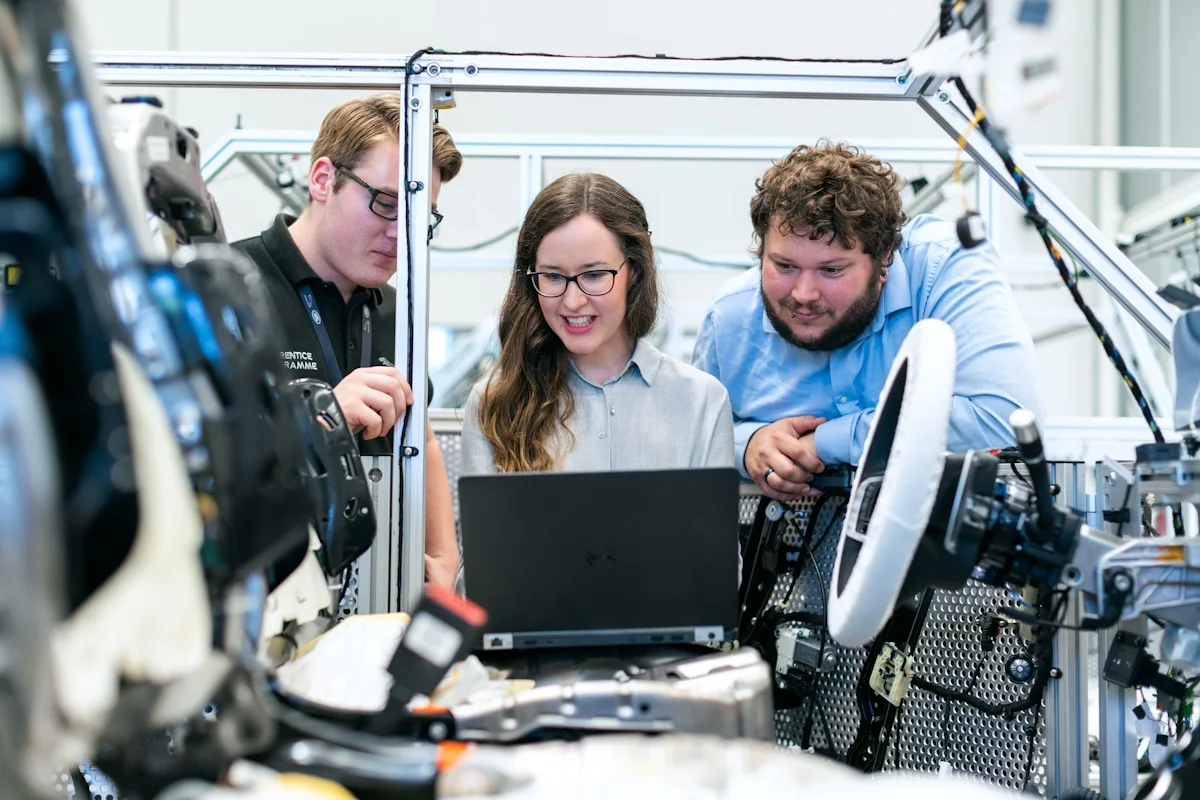
Factory robotics has evolved from fixed, caged industrial arms to AI-guided systems that perceive their environment, adapt to variation, and work safely alongside human operators. The gap between the robotics marketing and operational reality remains significant in 2026 — here’s an honest assessment of what AI robotics is actually delivering in production environments versus what remains aspirational.
Collaborative Robots (Cobots): Proven Value in Flexible Manufacturing
Collaborative robots — designed to work safely alongside humans without safety caging — have found their most effective deployment in flexible, low-to-medium volume manufacturing where full automation isn’t economically justified and product variety requires adaptability. Universal Robots, the cobot market leader, has 75,000+ deployments across automotive, electronics, food processing, and medical device manufacturing.
Where Cobots Deliver Consistent ROI
The highest-value cobot applications share common characteristics: repetitive, ergonomically demanding tasks with consistent part presentation; operations where quality consistency matters more than throughput speed; and environments where frequent product changeovers make fixed automation impractical. Machine tending (loading/unloading CNC machines), screw driving, soldering, pick-and-place for packaging, and laboratory sample handling are cobot deployments with the most consistent ROI documentation.
Universal Robots customer data shows average payback periods of 12-18 months for these applications, with labor savings of 1-2 FTEs per cobot in three-shift operations. Importantly, cobots in these deployments aren’t typically replacing workers — in labor-scarce manufacturing environments, they’re filling positions that couldn’t be staffed, or handling tasks that cause repetitive strain injuries that drive turnover.
Autonomous Mobile Robots: Transforming Internal Logistics
Autonomous Mobile Robots (AMRs) — self-navigating robots that transport materials through factory and warehouse environments — represent the fastest-growing segment of industrial robotics in 2026. Unlike fixed conveyor systems, AMRs navigate dynamically using LIDAR, computer vision, and AI path planning, adapting routes in real time around obstacles and changing production layouts.
Fetch Robotics and Mobile Industrial Robots (MiR)
Fetch Robotics (acquired by Zebra Technologies) and MiR dominate the manufacturing AMR market. In electronics manufacturing — where kitting (delivering component kits to assembly stations) is labor-intensive and error-prone — AMR systems have demonstrated 40-60% reductions in material handling labor while improving delivery accuracy. A Flextronics facility deploying 40 Fetch AMRs reported eliminating 25 material handler positions while simultaneously improving on-time material delivery from 87% to 99.4%.
AI-Guided Assembly: Progress and Realistic Limitations
Vision-guided robotic assembly — using AI computer vision to locate parts and guide assembly operations rather than relying on precise fixture positioning — is the application generating the most enthusiasm and the most disappointment in 2026. The technology works well for specific, well-defined problems; it remains brittle in complex, variable assembly environments.
What Works: Structured Bin Picking
AI-guided bin picking — reaching into a bin of randomly oriented parts and grasping specific components — has reached commercial viability for a defined class of parts. Systems from Fanuc (3D Area Sensor), KUKA, and specialized vendors like RightHand Robotics reliably pick prismatic parts (regular geometric shapes) and some complex parts with sufficient training. Cycle times of 2-4 seconds per pick are achievable for suitable parts, enabling automation of a task that previously required human dexterity.
What Doesn’t Work Yet: Highly Variable, Flexible Assembly
Assembling complex products with many component types, varying orientations, and tolerance requirements that demand human tactile feedback — automotive wire harness assembly, complex electromechanical assembly, or intricate product assembly — remains beyond the reliable capability of current AI robotics systems at production-required speeds and quality levels. The wiring harness problem in particular has been “two years from automation” for over a decade; despite significant advances in AI and robot dexterity, the combination of flexible components, variable routing, and connector insertion requiring tactile feedback continues to resist automation.
The Human-Robot Collaboration Reality
The most successful factory robotics implementations in 2026 are not full automation — they’re carefully designed human-robot collaboration where each does what it does best. Robots handle the high-force, high-precision, high-repetition tasks; humans handle the variable, judgment-intensive, exception-handling tasks. Factory designs that thoughtfully allocate tasks based on these respective strengths consistently outperform both full manual assembly and attempted full automation in terms of quality, flexibility, and economics.
Related: AI in Manufacturing 2026 | Predictive Maintenance AI | AI Quality Control
Authoritative source: The International Federation of Robotics annual report provides the most comprehensive global data on industrial robot deployments by region, industry, and application — essential context for understanding where AI robotics is delivering proven ROI versus where deployments remain experimental.
Related Reading
- AI in Manufacturing 2026: Industry 4.0 Complete Guide
- Predictive Maintenance with AI: Reduce Downtime by 50% in 2026
- AI Quality Control in Manufacturing: Computer Vision Systems in 2026
- AI Supply Chain Optimization for Manufacturers in 2026
- Digital Twins and AI: How Smart Factories Model the Future in 2026