
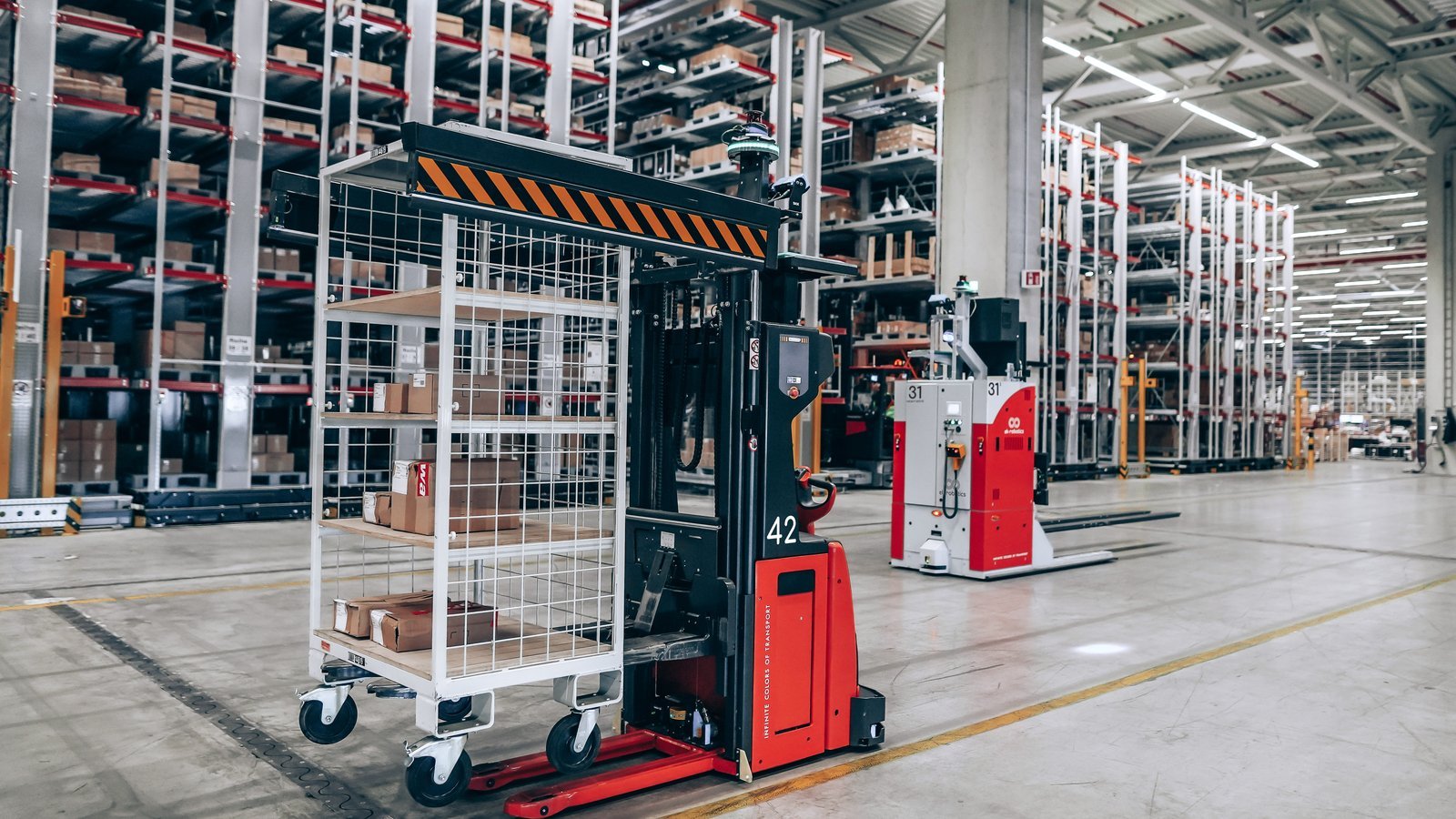
The warehouse is where AI automation has delivered some of its most dramatic productivity improvements. E-commerce growth has created both the demand pressure — order volumes that manual fulfillment cannot scale to meet — and the capital availability to invest in AI-powered automation. Here’s what’s working at scale in 2026 and what’s still aspirational.
Autonomous Mobile Robots: The Proven Foundation
AMRs — robots that navigate dynamically through warehouse environments using LIDAR and AI path planning — have become standard equipment in e-commerce fulfillment. Amazon’s 750,000+ robot fleet includes multiple AMR types: Kiva-derived drive units that bring shelves to pickers (eliminating the majority of picker walking time), Proteus AMRs that navigate autonomously in areas with human workers, and Hercules AMRs for heavy pallet movement.
The “goods-to-person” model enabled by AMRs — robots bring inventory to stationary pickers rather than pickers walking to inventory — is the most productivity-impactful application. Walking represents 50-70% of a picker’s time in traditional warehouses; eliminating it increases pick rates from 60-100 units per hour to 200-400 units per hour. Amazon fulfillment centers with full AMR deployment process 25% more orders from equivalent floor space compared to non-automated facilities.
AI Robotic Picking: Progress and Limits
What’s Working: Structured Product Categories
AI robotic picking — using computer vision and robotic arms to pick individual items from warehouse locations — has achieved commercial viability for specific product categories. Mujin and RightHand Robotics deploy picking robots in distribution centers handling consistent product formats (books, boxed consumer goods, bagged items) with documented pick rates of 600-1200 units per hour and error rates below 0.5%.
Ocado, the UK grocery technology company, has built the world’s most automated grocery fulfillment system — its Customer Fulfillment Centers use AI-guided robots to pick entire grocery orders in minutes. Ocado’s system handles the full complexity of grocery SKUs (different sizes, shapes, fragility levels) through careful engineering of the storage and retrieval system around robotic capabilities rather than attempting general-purpose robotic dexterity.
What’s Still Hard: Unstructured Environments
General-purpose robotic picking — reaching into a mixed bin of diverse items and picking a specified product — remains difficult. The challenge is the combination of visual recognition (identifying the target item among many), grasp planning (determining how to grasp an irregular object reliably), and execution (performing the grasp and transfer without dropping or damaging the item). For high-SKU-count e-commerce fulfillment where any of 500,000 products might need to be picked, achieving the reliability and speed of experienced human pickers remains an open engineering challenge.
AI Inventory Management: Knowing Where Everything Is
Inventory accuracy — knowing precisely where each item is in a warehouse — is the foundation of efficient fulfillment. Traditional inventory management relies on periodic cycle counts (manual counting of inventory sections) and barcode scans at key handling points. AI is enabling continuous, automated inventory monitoring through two approaches.
Drone-based inventory scanning — autonomous drones flying warehouse aisles and scanning barcodes or RFID tags — provides complete inventory counts without human labor. Gather AI and Corvus Systems deploy drones that scan large distribution center inventory in hours rather than the days required for manual cycle counts, with scan accuracy above 99.9%. For a warehouse where inventory inaccuracy causes 2-3% of orders to fail or ship incorrectly (a common benchmark), improving inventory accuracy to 99.9%+ directly reduces costly order failures.
Computer vision inventory monitoring — cameras covering storage locations that use AI to detect product presence/absence and quantity — provides continuous inventory visibility without scanning. AutoStore’s cube storage system with integrated vision monitoring maintains real-time inventory accuracy across millions of items in dense automated storage configurations.
The Full Stack: What Best-in-Class Looks Like
The highest-performing warehouse operations in 2026 combine: AMRs for goods-to-person fulfillment (productivity), AI robotic picking for suitable product categories (labor reduction), computer vision quality control (error prevention), drone inventory scanning (accuracy), and AI warehouse management systems that optimize slotting (placing fast-moving items in optimal locations), wave planning (batching orders for maximum pick efficiency), and labor allocation. This full-stack automation delivers throughput 3-5x higher than manual operations from equivalent floor space with 40-60% lower labor cost per unit processed.
Related: AI in Transport 2026 | AI Route Optimization | AI Demand Forecasting Logistics
Authoritative source: The MHI Warehouse Automation resources provide the most comprehensive industry data on warehouse automation technology adoption, performance benchmarks, and ROI calculations — including the annual Warehouse/DC Operations Survey that tracks automation investment trends and documented productivity outcomes across hundreds of distribution operations.