Best Multimodal AI Models: Complete 2026 Comparison Guide
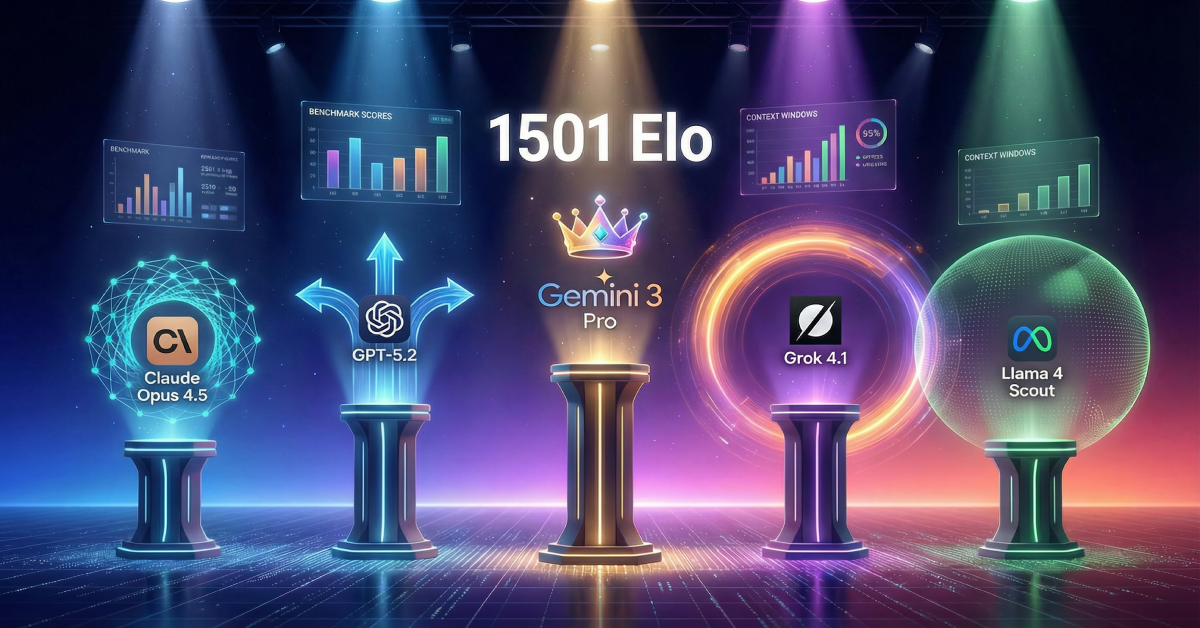
The best multimodal AI models of late 2025 just rewrote the capability ceiling—and the price floor. Google’s Gemini 3 Pro dethroned every competitor with a historic 1501 Elo rating on LMArena while processing 1 million tokens in unified inference sessions. OpenAI fired back weeks later with GPT-5.2, slashing API costs 40% while expanding context to 400,000 tokens across three specialized variants. Anthropic’s Claude Opus 4.5 countered with extended thinking modes that spend hours reasoning through complex problems, and xAI’s Grok 4.1 undercut everyone at $0.20 per million tokens with a 2 million token context window.
Meanwhile, Meta’s open-source Llama 4 Scout quietly achieved what seemed impossible six months ago: a 10 million token context window—enough to process entire books, massive codebases, or comprehensive document collections without chunking. Organizations choosing models today face dramatically different economics and capabilities than those selecting systems just three months ago, making outdated comparisons actively misleading for strategic decisions.
This guide cuts through marketing claims with verified benchmarks, real API pricing, and practical deployment insights across eight leading multimodal AI models. Whether you’re building customer-facing applications, autonomous agents, or research tools, understanding which model aligns with your specific workload determines both immediate success and avoided regret when capabilities or costs shift unexpectedly.
What Defines Best Multimodal AI Models in 2026
Best multimodal AI models excel across genuine cross-modal understanding, not merely processing different formats sequentially. When Gemini 3 Pro achieves 81% on MMMU-Pro—expert-level multimodal understanding—it demonstrates detecting contradictions between image content and textual claims, synthesizing insights from video visuals alongside spoken audio, and reasoning about spatial relationships in ways that earlier models completely missed.
Organizations selecting these multimodal AI models today must understand how they differ fundamentally from traditional large language models that process only text. Cross-modal capabilities enable applications impossible with single-format alternatives—simultaneously analyzing customer complaint text, uploaded product damage photos, and voice call tone to detect patterns that text-only systems miss entirely.
Context window capacity now spans three orders of magnitude from 128,000 to 10,000,000 tokens, fundamentally changing what’s architecturally possible. GPT-5.2’s 400,000 tokens handle comprehensive codebases or multi-hour meeting transcripts. Grok 4.1’s 2 million tokens process full novels or extensive financial document sets. Llama 4 Scout’s 10 million tokens analyze entire organizational wikis or research literature corpuses—all without chunking that loses coherent cross-document understanding.
Reasoning modes separate pattern matching from genuine problem-solving. Claude Opus 4.5’s extended thinking spends minutes or hours on complex queries through explicit chain-of-thought processing, backtracking when initial approaches fail. DeepSeek V3.1’s hybrid inference toggles between fast responses and deep reasoning based on query complexity, optimizing both user experience and computational efficiency.
Cost structures vary 100x for equivalent capability levels, with pricing wars accelerating through late 2025. Grok 4.1 charges $0.20 per million input tokens—84% cheaper than GPT-5.1—while Llama 4 Scout eliminates marginal API costs entirely through open-source licensing. Organizations optimizing total cost of ownership across development, deployment, and operation find dramatically different winners depending on usage patterns and technical capabilities.
Gemini 3 Pro: The Benchmark King
Gemini 3 Pro, launched November 17-18, 2025, achieved unprecedented rankings across every major benchmark while maintaining a 1 million token context window. The model topped LMArena with a 1501 Elo rating, scored 91.9% on GPQA Diamond (PhD-level science questions), and achieved 81% on MMMU-Pro—a 5-point lead over GPT-5.1 in expert multimodal understanding that competitors haven’t closed despite aggressive releases.
Multimodal Excellence
Video understanding reaches 87.6% on Video-MMMU, processing multi-hour content to extract insights from visual frames, spoken audio, on-screen text, and scene transitions simultaneously. This enables analyzing entire conference presentations to generate summaries capturing both slide content and speaker emphasis, reviewing product demo videos to create detailed feature documentation, or monitoring security footage with contextual awareness spanning hours rather than isolated frame analysis.
Mathematical reasoning demonstrates 95% accuracy on AIME 2025 without tools, with performance jumping to perfect 100% scores when granted code execution access. The model’s 23.4% on MathArena Apex represents a 20x improvement over previous leaders on this deliberately unsolved challenge designed to resist saturation—suggesting genuine reasoning advancement rather than benchmark memorization.
Factual accuracy hits 72.1% on SimpleQA Verified, a benchmark specifically designed to catch hallucinations and confident incorrect responses. This reliability matters critically for applications where wrong answers create liability—medical information lookup, financial analysis, legal research—where previous models’ tendency to confidently hallucinate plausible-sounding nonsense made them too risky for production deployment.
Deep Research and Agentic Capabilities
Deep Research mode operates autonomously for extended periods, following citation trails across hundreds of sources, cross-referencing claims, validating facts through multiple independent confirmations, and synthesizing comprehensive reports that rival human expert analysis. This capability transforms multimodal search optimization by enabling AI systems to verify information across text documents, research papers, and video content simultaneously, catching inconsistencies that single-source analysis misses entirely.
When asked to research complex topics like “comparative effectiveness of different cancer immunotherapy approaches,” the system spends hours reading medical literature, evaluating study quality, identifying contradictions, and producing structured summaries with proper citations. This autonomous research eliminates the manual coordination previously required when synthesizing insights from diverse sources spanning academic papers, clinical trial databases, and medical conference recordings.
Agentic tool use enables coordinated workflows spanning search, code execution, document retrieval, and API calls. The model determines when external information would improve responses, calls appropriate tools, integrates results into reasoning chains, and continues processing unified workflows blending internal knowledge with real-time external data seamlessly.
Access and Pricing
Free tier users receive 5 daily reasoning queries and 20 standard queries. Google AI Pro subscribers ($30/month) get 100 daily reasoning queries, 1,000 image generations via Nano Banana Pro, and expanded Deep Research access. Google AI Ultra (premium tier) unlocks unlimited reasoning, Veo 3.1 video generation (3 daily videos), and enterprise features including priority API access and extended support.
GPT-5.2: OpenAI’s Unified Powerhouse
GPT-5.2, released December 11, 2025, unified reasoning capabilities previously fragmented across multiple models while aggressively cutting API pricing. The system processes text, images, audio, and video with 400,000 token context windows—double GPT-5.1’s capacity—across three specialized variants optimizing different use cases.
Three-Variant Architecture
GPT-5.2 Instant delivers near-instant responses for straightforward queries, optimizing latency and cost for applications like customer support chatbots, content moderation, or simple document analysis where sub-second response times create better user experiences. Pricing starts at $1.75 per million input tokens—40% cheaper than GPT-5.1—making high-volume applications economically viable.
GPT-5.2 Thinking applies extended reasoning with visible chain-of-thought processing for complex problems requiring systematic decomposition. The model shows its work, enabling users to verify reasoning paths, identify where logic might fail, and understand why specific conclusions emerged—critical for debugging, educational applications, and regulated industries requiring explainable AI decisions.
GPT-5.2 Pro balances performance and cost for demanding applications, priced at $21 per million input tokens and $168 per million output tokens. This tier handles sophisticated multimodal reasoning, extensive code generation, and complex document synthesis where cutting-edge capability justifies premium pricing relative to standard variants.
Vision and Coding Strengths
Vision capabilities represent GPT-5.2’s strongest advancement over predecessors, with error rates cut roughly in half on tasks like chart analysis, UI understanding, and spatial reasoning. The system correctly identifies and labels computer motherboard components with positional accuracy, analyzes dashboard layouts to extract specific metrics from complex visualizations, and understands architectural drawings to answer detailed questions about spatial relationships.
Multi-language code generation spans Python, JavaScript, SQL, Java, and more with sophisticated debugging through stepwise analysis. When code fails, GPT-5.2 systematically traces execution, identifies root causes, proposes targeted fixes, and validates solutions—compressing debugging cycles that previously required extensive human intervention into automated workflows that handle end-to-end development tasks.
These capabilities prove particularly valuable in content creation workflows where marketing teams coordinate text generation, image analysis, and video script development within unified processes. Rather than switching between specialized tools for each format, GPT-5.2 handles multimodal content coordination that maintains brand consistency while accelerating production timelines from days to hours.
Context Caching Economics
Prompt caching delivers 90% discounts on repeated input tokens, dropping costs to $0.175 per million cached tokens. For applications processing standard prompts repeatedly—customer support analyzing product documentation with every query, code assistants working within established codebases, research tools referencing consistent knowledge bases—caching transforms economics by eliminating charges for unchanging context across thousands of inferences.
Claude Opus 4.5: The Reasoning Specialist
Claude Opus 4.5, released November 23, 2025, prioritizes depth over speed with extended thinking modes spending minutes or hours on genuinely challenging problems. This specialized focus distinguishes it from models optimizing average-case performance, making Claude the go-to choice when correctness matters more than latency.
Extended Thinking Architecture
Extended thinking mode processes complex queries through explicit multi-step reasoning visible to users as “thinking” blocks showing intermediate logic. The model breaks down problems, evaluates approaches, backtracks from dead ends, and validates conclusions before delivering final answers—transparency that builds trust for high-stakes applications where black-box decisions feel too risky.
Long-horizon reasoning maintains coherence across dozens of steps without drift or loss of context. Previous models degraded on multi-phase tasks—losing track of earlier constraints, contradicting previous conclusions, or forgetting key context—but Opus 4.5’s architecture specifically optimizes sustained reasoning that doesn’t degrade even across hundreds of interaction turns.
Memory Files and Persistent Context
When granted local file access through Claude Code or enterprise deployments, Opus 4.5 creates and maintains “memory files” storing key information across sessions. These persistent memory structures enable genuine long-term project awareness impossible with context windows alone—the model remembers project requirements from weeks ago, tracks evolving codebases, maintains understanding of complex systems developed incrementally over extended periods.
A notable demonstration saw Claude Opus 4.5 playing Pokémon while creating a comprehensive Navigation Guide documenting locations, NPCs, quest progression, and strategic insights. This autonomous long-horizon behavior—maintaining coherent goals across thousands of steps, building structured knowledge artifacts, planning strategies requiring multi-stage execution—suggests genuine agentic capability rather than sophisticated pattern matching.
Autonomous Coding and Research
Claude Code enables background coding sessions spanning thousands of steps where Opus 4.5 autonomously refactors entire modules, implements new features from specifications, or debugs complex issues requiring systematic investigation. Organizations implementing these AI coding workflows report 40-60% productivity improvements as developers focus on architecture and business logic while AI handles routine implementation, testing, and documentation tasks.
The 32,000 token output capacity supports generating comprehensive code with extensive documentation, test suites, and explanatory comments in single responses. This eliminates the fragmented development cycles where developers assemble partial outputs from multiple queries into coherent implementations.
Research workflows operate autonomously for hours, exploring topics through citation trails, cross-referencing sources, validating claims, identifying contradictions, and synthesizing findings into comprehensive reports. Marketing campaigns benefit from multi-step execution planning strategies, generating creative assets, analyzing performance data, and iteratively optimizing based on results without requiring human intervention at each step.
Pricing and Enterprise Access
API pricing reflects the dual-mode architecture—instant responses cost standard rates competitive with other frontier models, while extended thinking commands premium pricing justified by minutes or hours of compute per query. Enterprise customers deploy Claude models in private cloud environments via Amazon Bedrock or Google Cloud Vertex AI for sensitive applications requiring data isolation and compliance guarantees.
Grok 4.1: The Cost-Performance Disruptor
Grok 4.1, released November 17-18, 2025 by xAI, rewrote cost-performance economics with $0.20 per million input tokens—84% cheaper than GPT-5.1—while matching or exceeding competitor capabilities in context length and emotional intelligence.
Massive Context at Minimal Cost
The 2 million token context window matches Gemini 3 Pro’s capacity at a fraction of the price, enabling processing of full novels, massive codebases, or extensive financial document collections without chunking. This 8x advantage over GPT-5.1’s 250,000 tokens and 10x over Claude Sonnet 4.5’s 200,000 tokens makes Grok optimal for applications where context depth directly determines utility.
Cost advantages compound dramatically at scale. An application processing 100 million tokens monthly—typical for moderate customer support chatbots or document analysis services—costs $20 with Grok 4.1 versus $1,250 with competitors, generating annual savings exceeding $14,000 before accounting for reduced infrastructure and operational overhead.
Hallucination Reduction and X Integration
Reinforcement learning improvements reduced hallucination rates 3x compared to Grok 4, addressing a critical weakness that previously made the model too unreliable for production applications requiring factual accuracy. This enhanced truthfulness, verified through SimpleQA-style benchmarks, positions Grok as viable for customer-facing applications where confident incorrect responses damage brand trust.
Exclusive X (formerly Twitter) platform integration provides real-time social media data access unavailable to competitors. Applications monitoring brand sentiment, detecting emerging trends, analyzing public discourse, or generating crisis alerts leverage unique data advantages that matter substantially for social media intelligence use cases.
API Variants and Deployment
Two optimized variants serve different needs: grok-4-1-fast-reasoning handles tool calling, web search, and agentic workflows requiring systematic planning, while grok-4-1-fast-non-reasoning optimizes speed for straightforward queries where latency matters more than deep analysis. Both support the full 2 million token context window with identical pricing, enabling developers to match variant to specific application requirements.
Llama 4 Scout: The Open-Source Champion
Llama 4 Scout, released April 5, 2025 by Meta, achieved the seemingly impossible: a 10 million token context window—100x larger than GPT-4o and 10x beyond Gemini 3 Pro. This breakthrough enables processing entire books, organizational wikis, or comprehensive research literature without chunking that loses cross-document coherence.
Revolutionary Context Architecture
The 10 million token capacity leverages hybrid attention mechanisms combining RoPE (Rotary Position Embeddings) and NoPE (No Position Embeddings) layers with optimized normalization strategies from Cohere research. This architecture maintains attention quality across extreme lengths where naive scaling would fail catastrophically as softmax probabilities collapse toward uniform distributions.
Practical applications transform when context expands 10-100x. Legal teams process complete case files including transcripts, exhibits, and precedent research in unified inference sessions. Software engineers analyze entire enterprise codebases to understand architectural patterns spanning hundreds of files. Researchers synthesize complete literature corpuses identifying knowledge gaps across thousands of papers—tasks architecturally impossible with smaller contexts.
Mixture-of-Experts Efficiency
The 17 billion active parameters from 109 billion total enable inference efficiency rivaling models one-tenth the size while maintaining capability competitive with frontier closed-source alternatives. This MoE design activates only relevant expert sub-networks per token, achieving favorable cost-performance ratios that make deployment feasible on consumer-grade hardware through quantization.
Open-weight licensing eliminates ongoing API costs for organizations with technical capacity to manage infrastructure, shifting economics from operational expenses scaling with usage to capital investments in compute hardware. Break-even analysis typically favors self-hosting above 500,000 queries monthly, though exact thresholds depend on query complexity and hardware already available.
Community Ecosystem Advantages
Meta’s commitment to open weights fostered extensive development through Hugging Face model repositories, Ollama desktop deployment, llama.cpp optimization libraries, and MLX Apple Silicon support. This ecosystem provides fine-tuning tools, quantization guides, deployment templates, and specialized variants optimized for specific domains—medical analysis, legal reasoning, code generation—without vendor dependencies limiting customization.
DeepSeek V3.1: The Hybrid Reasoner
DeepSeek V3.1, released August 21, 2025, introduced hybrid inference modes toggling between fast responses and extended thinking based on query complexity. This flexibility optimizes both user experience and computational efficiency better than models locked into single processing modes.
Think and Non-Think Modes
Non-thinking mode delivers instant responses for straightforward queries—factual lookups, simple coding tasks, document summarization—where speed matters more than deep reasoning. Thinking mode activates automatically for complex problems requiring multi-step analysis, spending additional time on systematic decomposition that improves accuracy on challenging mathematical, scientific, or logical reasoning tasks.
The hybrid architecture enables cost-optimized workflows applying expensive extended reasoning only when genuinely beneficial. Applications route routine queries through non-thinking mode at standard API rates, escalating to thinking mode only for edge cases requiring sophisticated analysis—maximizing capability while controlling costs through intelligent mode selection.
Enhanced Agent Capabilities
Post-training boosts targeting tool use and multi-step agent tasks improved performance on SWE-bench (software engineering) and Terminal-Bench (command-line) evaluations. These targeted improvements make DeepSeek particularly strong for autonomous coding assistants, DevOps automation agents, and systems integration workflows requiring coordinated multi-tool execution.
Strict function calling support enables reliable structured outputs for applications demanding predictable formats—database queries, API calls, JSON generation. Previous models occasionally hallucinated invalid function calls or malformed outputs requiring expensive validation layers, but V3.1’s strict mode guarantees syntactically correct structured responses.
Open-Source Economics
Like earlier DeepSeek versions, V3.1 maintains open-source licensing enabling self-hosting without ongoing API costs. The 128,000 token context handles comprehensive document analysis and extended conversations while remaining deployable on accessible hardware configurations—24GB+ GPUs like NVIDIA RTX 4090 or A6000 support quantized inference at reasonable speeds for medium-volume applications.
Open-Source Multimodal Alternatives
Beyond major commercial offerings, specialized open-source multimodal AI models serve organizations prioritizing transparency, customization, or cost control over bleeding-edge performance.
LLaVA: Visual Question Answering
LLaVA (Large Language and Vision Assistant) combines Vicuna language models with CLIP vision encoders, achieving 92.53% on Science QA dataset—competitive with commercial alternatives on chat-related visual reasoning. Open licensing enables creating domain-specific visual chatbots for e-commerce product search, museum guide applications, or accessibility tools describing images for visually impaired users.
CogVLM: Deep Fusion Architecture
CogVLM employs advanced fusion techniques achieving state-of-the-art performance across 17 cross-modal benchmarks including image captioning and visual question answering. The cognitive architecture emphasizes coherent reasoning across vision and language, producing detailed image descriptions and answering complex questions requiring synthesis of visual understanding with linguistic knowledge.
Comparison Table
| Model | Context Window | Key Capability | Best Use Case | Cost Structure |
|---|---|---|---|---|
| Gemini 3 Pro | 1M tokens | #1 benchmarks, video reasoning | Research, video analysis, comprehensive documents | Free tier + $30/mo Pro + Premium Ultra |
| GPT-5.2 Instant | 400K tokens | Fast multimodal, vision | Customer support, content moderation | $1.75/1M input, $14/1M output |
| GPT-5.2 Thinking | 400K tokens | Extended reasoning, coding | Complex debugging, research | $1.75/1M input + reasoning premium |
| GPT-5.2 Pro | 400K tokens | High-end multimodal | Enterprise applications | $21/1M input, $168/1M output |
| Claude Opus 4.5 | 200K+ tokens | Extended thinking, memory files | Autonomous agents, long-horizon tasks | API standard + extended mode premium |
| Claude Sonnet 4.5 | 200K tokens | Balanced coding, analysis | Daily enterprise workflows | API competitive rates |
| Grok 4.1 | 2M tokens | Massive context, low cost | Budget apps, X integration | $0.20/1M input (84% cheaper) |
| Llama 4 Scout | 10M tokens | Industry-leading context | Books, massive codebases, research | Open-weight (self-hosting costs only) |
| DeepSeek V3.1 | 128K tokens | Hybrid Think/Non-Think | Agent workflows, tool use | Open-source + hosting |
Choosing Your Multimodal AI Model
Match Context Needs to Window Size
Applications processing comprehensive documents, multi-hour videos, or extensive codebases require context windows matching content volumes. Understanding the difference between multimodal and unimodal AI helps clarify when massive context windows deliver genuine value versus when simpler single-format models suffice—many organizations overestimate multimodal requirements for use cases that text-only processing handles adequately.
Gemini 3 Pro’s 1 million tokens handles full-length books or conference recordings. Grok 4.1’s 2 million tokens manages extensive financial document collections. Llama 4 Scout’s 10 million tokens processes entire organizational wikis or research literature without chunking that loses cross-document coherence.
Conversely, customer support analyzing individual messages or content moderation reviewing single posts wastes resources on massive contexts delivering no incremental value. GPT-5.2 Instant’s 400,000 tokens suffices for 99% of these applications while optimizing latency and cost through streamlined processing.
Evaluate True Total Cost
API pricing comparisons mislead when ignoring usage patterns, caching opportunities, and operational overhead. Applications with consistent prompt structures benefit enormously from GPT-5.2’s 90% caching discounts, transforming effective costs dramatically. High-volume services processing millions of queries monthly often find Grok 4.1’s 84% cost advantage or Llama 4’s zero marginal costs justify infrastructure investments in self-hosting.
Calculate total cost of ownership including development time, debugging complexity, integration effort, and ongoing maintenance—not just per-token API fees. Simpler unimodal alternatives solving 80% of use cases at 10% of complexity often deliver better ROI than forcing multimodal sophistication onto fundamentally straightforward problems.
Test Extended Reasoning Value
Extended thinking modes (Claude Opus 4.5, GPT-5.2 Thinking, DeepSeek V3.1 Think) command premium pricing justified only when correctness genuinely requires multi-step systematic analysis. Pilot test whether deep reasoning improves outcomes measurably versus instant responses on your actual workload before committing architectures around expensive extended modes that might add cost without proportional value.
Many applications overestimate reasoning requirements—simple classification, straightforward extraction, or routine analysis rarely benefit from extended thinking despite intuition suggesting otherwise. Empirical A/B testing comparing instant versus extended modes on representative queries builds evidence guiding intelligent mode selection rather than defaulting to maximum capability regardless of need.
Consider Ecosystem Lock-in
Models deeply integrated with existing platforms—Gemini with Google Workspace, potential Grok advantages within X—reduce friction for organizations already committed but create switching costs limiting future flexibility. Standalone API access (GPT-5.2, Claude, DeepSeek) offers portability at the expense of requiring custom integration work connecting AI capabilities to business systems.
Open-source alternatives provide maximum optionality enabling migration between hosting providers, customization through fine-tuning, and architectural modifications optimizing for specific requirements. This flexibility matters most when current optimal choices likely shift within months as capabilities advance and new entrants emerge in this rapidly evolving landscape.
Real-World Applications
Autonomous Research Agents
Claude Opus 4.5 powers research agents exploring complex topics for hours or days, autonomously following citation trails across hundreds of papers, cross-referencing claims, validating facts, and synthesizing comprehensive reports. When asked to research “comparative effectiveness of different cancer immunotherapy approaches,” the system reads medical literature, evaluates study quality, identifies contradictions, and produces structured summaries rivaling human expert analysis.
Gemini 3 Pro’s Deep Research handles similar workflows with 1 million token contexts enabling processing of entire literature corpuses in unified sessions. The model connects insights across temporally separated publications, detecting emerging patterns and knowledge gaps that manual review might miss across thousands of sources.
Massive Document Analysis
Financial analysts deploy Grok 4.1’s 2 million token context processing hundreds of quarterly reports, earnings transcripts, and market analyses simultaneously. The unified inference session maintains coherent cross-document understanding, identifying trends and anomalies impossible to surface through chunked analysis that loses relationships between separated content.
Legal teams leverage Llama 4 Scout’s 10 million tokens reviewing complete case files including transcripts, exhibits, precedent research, and supporting documentation without pagination or summarization that risks losing critical details. This comprehensive context enables identifying relevant precedents, contradictions in testimony, or procedural issues that fragmented analysis might overlook.
Customer Support Automation
GPT-5.2 Instant handles text chat, voice calls, and image uploads within unified customer support conversations. Customers photograph damaged products while describing issues, with the model analyzing visual damage, understanding concerns, accessing order histories, and providing comprehensive resolutions without channel-switching friction that reduces satisfaction and increases operational costs.
These AI customer support solutions integrate seamlessly with existing CRM systems, automatically categorizing tickets, routing complex cases to specialized teams, and maintaining conversation context across multiple channels—capabilities that traditional chatbots processing only text cannot match.
Vision capabilities distinguish genuine product defects from cosmetic issues or user error, automatically routing cases appropriately—issuing refunds for legitimate claims while escalating ambiguous situations to human review. This automation handles 70-80% of routine support queries entirely, dramatically reducing operational costs while maintaining satisfaction through instant accurate resolutions.
Enterprise Coding Assistants
Claude Opus 4.5 runs background coding sessions spanning thousands of steps, autonomously refactoring modules, implementing features from specifications, or debugging complex issues requiring systematic investigation. Organizations implementing these AI coding workflows report 40-60% productivity improvements as developers focus on architecture and business logic while AI handles routine implementation, testing, and documentation tasks.
The 32,000 token output supports comprehensive code generation with extensive documentation, test suites, and explanatory comments in single responses—eliminating fragmented development cycles where developers assemble partial outputs from multiple queries into coherent implementations.
DeepSeek V3.1’s enhanced agent capabilities excel at DevOps automation—coordinating deployments across environments, monitoring system health, executing rollbacks on failures, and synthesizing incident reports documenting root causes and remediation steps. Strict function calling guarantees reliable structured outputs for database queries and API calls without hallucinated invalid commands.
Building Your Multimodal AI Strategy
Selecting the right multimodal AI models represents just one component of comprehensive AI strategy. Organizations achieving measurable ROI combine model selection with thoughtful implementation planning that addresses data preparation, user experience design, change management, and iterative optimization based on real usage patterns rather than theoretical capabilities.
Start with pilot projects testing leading candidates on representative workloads before committing architecture and budget to specific models. The multimodal AI landscape evolves rapidly—models leading benchmarks today may trail new entrants within months as capabilities advance and pricing pressures intensify. Maintain flexibility through abstracted implementations enabling model swapping as relative strengths shift without requiring application rewrites.
For organizations new to AI adoption, beginning with focused AI for small business applications proves value before scaling to enterprise-wide deployments. Text-only chatbots, simple document analysis, or basic image classification establish internal expertise and operational patterns that inform more sophisticated multimodal projects requiring coordination across vision, language, and audio processing simultaneously.
FAQ
What is the best multimodal AI model in 2026?
No single best multimodal AI model dominates all use cases in 2026—optimal choice depends on specific requirements. Gemini 3 Pro leads benchmarks with 1501 Elo and excels at video reasoning, making it best for research and comprehensive analysis. GPT-5.2 Instant optimizes cost and speed for customer-facing applications. Claude Opus 4.5 wins for complex reasoning requiring extended thinking. Grok 4.1 delivers unmatched cost-performance for budget-conscious applications. Llama 4 Scout’s 10 million tokens enables capabilities architecturally impossible with other models. Evaluate candidates against your actual workload characteristics, cost constraints, and integration requirements rather than chasing generic “best” rankings disconnected from use case realities.
How much does GPT-5.2 cost compared to competitors?
GPT-5.2 pricing varies by variant with Instant at $1.75 per million input tokens and $14 per million output tokens—40% cheaper than GPT-5.1. Pro costs $21 input and $168 output for high-end applications. Prompt caching delivers 90% discounts on repeated tokens, dropping effective costs dramatically for applications with consistent context. Comparatively, Grok 4.1 charges $0.20 per million tokens (88% cheaper), while Llama 4 Scout eliminates API costs through open-source licensing but requires self-hosting infrastructure. Total cost of ownership depends heavily on usage patterns, caching opportunities, and technical capacity to manage self-hosted alternatives versus API convenience.
Why does Llama 4 Scout have 10 million tokens?
Llama 4 Scout achieves 10 million tokens through hybrid attention mechanisms combining RoPE and NoPE layers with optimized normalization from Cohere research. This architecture maintains attention quality across extreme lengths where naive scaling fails as softmax probabilities collapse. The breakthrough enables processing entire books, organizational wikis, or comprehensive research literature without chunking that loses cross-document coherence. Practical applications include legal teams processing complete case files, software engineers analyzing entire enterprise codebases, and researchers synthesizing literature corpuses—tasks architecturally impossible with smaller contexts. This represents a 100x improvement over GPT-4o and 10x over Gemini 3 Pro’s already-impressive 1 million tokens.
Can I use these models offline or self-hosted?
Open-source models (Llama 4 Scout, DeepSeek V3.1, LLaVA, CogVLM) support offline self-hosting, eliminating ongoing API costs and enabling deployment in air-gapped environments for data sovereignty requirements. Hardware needs vary—Llama 4 Scout requires 24GB+ GPUs for quantized inference while full-precision demands 48GB+ configurations. DeepSeek V3.1 runs efficiently on consumer RTX 4090 or professional A6000 GPUs through INT8 quantization. Proprietary models (Gemini 3 Pro, GPT-5.2, Claude Opus 4.5, Grok 4.1) generally require API access, though enterprise customers sometimes negotiate private cloud deployments for sensitive applications. Self-hosting trades convenience and automatic updates for cost control and data isolation.
How do extended thinking modes work?
Extended thinking modes in Claude Opus 4.5, GPT-5.2 Thinking, and DeepSeek V3.1 Think allocate additional compute time for complex queries requiring multi-step systematic analysis. The models show explicit chain-of-thought reasoning as “thinking” blocks displaying intermediate logic, problem decomposition, approach evaluation, backtracking from dead ends, and validation before final answers. This transparency builds trust for high-stakes applications where black-box decisions feel too risky. Processing time ranges from seconds to minutes or hours depending on problem complexity. Pricing reflects extended compute—premium rates justified when correctness genuinely requires deep reasoning versus instant responses adequate for straightforward queries.
What makes Gemini 3 Pro rank #1?
Gemini 3 Pro achieved the unprecedented 1501 Elo rating on LMArena through superior performance across diverse benchmarks including 91.9% on GPQA Diamond (PhD-level science), 81% on MMMU-Pro (expert multimodal understanding—5 points ahead of GPT-5.1), 87.6% on Video-MMMU, and 72.1% on SimpleQA Verified (factual accuracy). Mathematical reasoning hits 95% on AIME 2025 without tools and perfect 100% with code execution. The 1 million token context enables comprehensive document analysis impossible with smaller windows. This combination of reasoning depth, multimodal excellence, factual reliability, and extreme context positions Gemini 3 Pro as the current benchmark leader, though GPT-5.2 and Claude Opus 4.5 compete closely on specific tasks.
Should I choose open-source or proprietary models?
Choose proprietary models (Gemini 3 Pro, GPT-5.2, Claude Opus 4.5) for maximum capability, polish, and convenience when cutting-edge performance justifies ongoing API costs and ecosystem lock-in acceptable. Select open-source alternatives (Llama 4 Scout, DeepSeek V3.1) for transparency, unlimited customization through fine-tuning, data sovereignty, and cost optimization when technical capacity exists to manage self-hosting complexity. Open models typically trail proprietary leaders by 6-18 months on capabilities but deliver 80-90% of performance on typical tasks at zero marginal costs for organizations managing infrastructure. Decision factors include budget constraints, data sensitivity requirements, customization needs, technical expertise available, and usage volumes where break-even favors self-hosting versus API convenience.
How accurate are these multimodal AI models?
Accuracy varies substantially by task type, domain, and model. Leading multimodal AI models achieve 80-95% on standard benchmarks like visual question answering, image captioning, and document analysis, though performance drops significantly on specialized domains, ambiguous inputs, or tasks requiring deep expert knowledge. Gemini 3 Pro’s 81% on MMMU-Pro and 91.9% on GPQA Diamond represent expert-level competence but still trail human expert baselines. Models excel at pattern recognition from training data but struggle with novel scenarios, complex reasoning requiring many steps, or detecting subtle contradictions across modalities. Factual accuracy improvements like Gemini’s 72.1% on SimpleQA Verified and Grok 4.1’s 3x hallucination reduction address critical reliability gaps but don’t eliminate need for validation on high-stakes applications.