ChatGPT prompts for business save 2-3 hours per task across every business function in 2026. The pattern is consistent: organizations with structured business prompt libraries produce reports 50-70% faster, draft contracts 40-60% faster, and generate proposals 60-75% faster — while maintaining the quality that client-facing work requires. These 25 templates cover the highest-frequency business tasks across strategy, operations, HR, finance, and sales.
Why Business Prompts Need Department-Specific Context
A CFO asking ChatGPT to “analyze our financial performance” needs different output than a sales manager asking the same question. Business prompts that specify the role, audience, decision, and format consistently outperform generic business prompts. Every template below includes the contextual wrapper that makes business AI output immediately useful.
Business ChatGPT prompt ROI in 2026 is highest for document-intensive workflows. McKinsey research found knowledge workers spend 28% of their workday on email alone, with report writing, proposal development, and contract review consuming additional significant time. ChatGPT prompts with detailed context specifications reduce first-draft production time by 50-75% for standardized business document types. The highest-impact business prompt categories by time saved: executive summaries (65-80% time reduction), job descriptions (55-70%), contract review briefs (40-60%), and competitive intelligence synthesis (60-80%). Organizations that have built formal prompt libraries for high-frequency business tasks — maintaining versioned templates per department — consistently achieve 35-45% more productivity improvement from AI than organizations where each employee develops ad-hoc prompts independently.
Strategy and Executive Prompts
Competitive Analysis Brief
Analyze [COMPETITOR] as a strategic competitor to [OUR COMPANY]. Based on: [PASTE AVAILABLE INFO]. Produce: (1) their apparent strategic priorities based on evidence, (2) where they are investing vs. pulling back, (3) signals about their 12-month direction, (4) 3 implications for our competitive position. Flag where you're inferring vs. where evidence is strong. Format as a 1-page brief.
SWOT Analysis
Run a SWOT analysis for [COMPANY/INITIATIVE] entering [MARKET/SITUATION]. For each quadrant: 4 specific points with the evidence or reasoning behind each (not generic statements). After the SWOT: identify the 2 most critical strategic questions to resolve, and the 1 combination of strengths+opportunities that represents our best path forward.
Board Presentation Narrative
Write the narrative for a board presentation slide deck on [TOPIC]. For each slide: [SLIDE TITLE] — 3-bullet key message, supporting data point, so-what implication. Slides: [LIST YOUR SLIDE TITLES]. Total: 1-2 bullet sentences per slide, not full paragraphs. Written for board members who will have 90 seconds per slide.
HR and People Operations Prompts
Job Description
Write a job description for a [ROLE] at a [COMPANY TYPE]. Requirements: [LIST MUST-HAVES AND NICE-TO-HAVES SEPARATELY]. Responsibilities: [LIST 5-7]. Culture differentiator: [WHAT MAKES THIS ROLE UNIQUE]. Format: avoid bias-coded language, separate must-have from preferred, lead responsibilities with outcomes not tasks, include specific growth opportunity.
Interview Questions (Behavioral)
Create 12 behavioral interview questions for a [ROLE] focusing on [COMPETENCY 1], [COMPETENCY 2], [COMPETENCY 3]. 4 questions per competency. For each question: the question (STAR format prompt), what a strong answer demonstrates, what a weak answer looks like. Mix difficulty levels. No: 'Where do you see yourself in 5 years', generic questions.
Performance Review Framework
Create a performance review framework for [ROLE]. Include: 5 core competencies to evaluate (specific to the role), 3-level performance description per competency (meets/exceeds/below expectations), 5 template sentences for strengths section, 5 template sentences for development areas section, 3 goal-setting prompt questions for the employee.

Sales and Customer Success Prompts
Sales Proposal
Write a sales proposal for [PROSPECT COMPANY TYPE] interested in [OUR SOLUTION]. Their situation: [DESCRIBE THEIR CHALLENGE]. Sections: executive summary (their problem + our solution in 100w), our approach (3 phases with deliverables), investment summary (placeholder table), why us (3 specific differentiators from competitors), next steps (specific and dated). 2-page maximum.
Cold Outreach Sequence (3 emails)
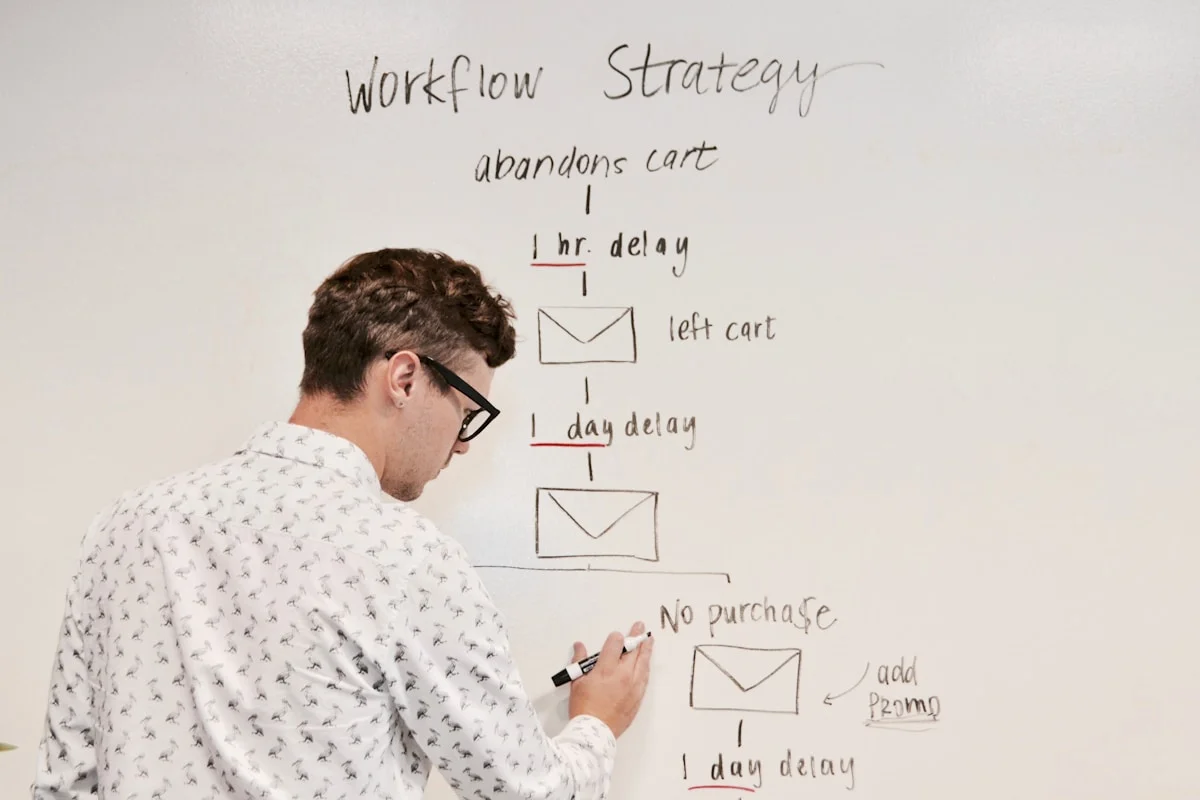
Write a 3-email cold outreach sequence for [PROSPECT ROLE] at [COMPANY TYPE] about [OUR OFFER]. Email 1 (Day 1): specific insight about their industry + offer relevance, no pitch, 80 words. Email 2 (Day 5): one specific result we achieved for a similar company, soft ask, 90 words. Email 3 (Day 12): direct ask, acknowledge it's the final email, 60 words. No: 'I hope this finds you well', generic claims.
Customer Success Check-In Email
Write a proactive check-in email from a CSM to a customer using [PRODUCT] for [TIME PERIOD]. Goal: uncover expansion opportunity or retention risk before it surfaces. Include: acknowledgment of their journey, 1 specific usage insight (placeholder), 1 feature they might not be using, 1 open question that reveals their current priority. 120 words max.
Finance and Legal Prompts
Financial Report Narrative
Write the narrative commentary for a financial report covering [PERIOD]. Data: [PASTE KEY METRICS]. Include: opening performance summary (3 sentences with headline metrics), revenue analysis (what drove performance, 2 sentences), cost analysis (key cost drivers, 2 sentences), outlook statement (forward-looking, appropriately hedged). No jargon. Written for board members, not accountants.
Contract Review Brief
Review this contract and produce a structured risk brief: [PASTE CONTRACT SECTIONS]. Identify: (1) top 3 risk clauses for our company with specific clause references, (2) missing standard protections we should negotiate, (3) terms that differ from market standard. Format for attorney review — note your analysis, flag where legal judgment is needed beyond this brief.
Budget Justification
Write a budget justification memo for [INITIATIVE] requesting [AMOUNT]. For: [DECISION MAKER TITLE]. Include: business case in 3 sentences, ROI calculation with assumptions stated, alternative options considered and why rejected, risk if not funded, requested approval by [DATE]. Under 400 words. Lead with the business outcome, not the cost.
For Claude AI’s enterprise business features, see our Claude AI complete guide. For the complete prompt engineering framework, see our prompt engineering guide.
Key Takeaways
- Business prompt libraries reduce first-draft production time 50-75% for standard document types
- Always specify the decision-maker audience — output changes significantly for CFO vs. line manager
- Contract review prompts produce structured risk briefs that accelerate attorney review, not replace it
- Sales proposal prompts with prospect context produce 3x more relevant output than generic templates
Related: Prompt Engineering Complete Guide | Claude AI Complete Guide 2026 | Best AI Marketing Tools 2026
Authoritative source: The McKinsey State of AI 2025 provides the enterprise productivity data on AI prompt adoption and time savings across business functions — the authoritative source for ROI benchmarks on business ChatGPT prompt implementation.