Future of Multimodal AI: Trends and Predictions (2026-2030)
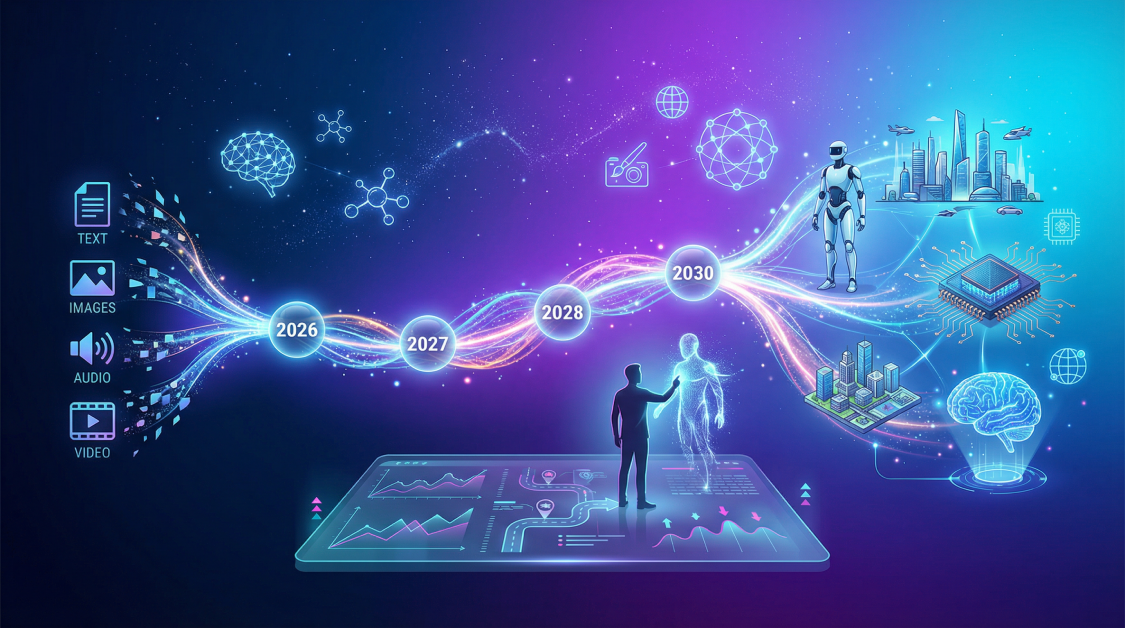
The future of multimodal AI will fundamentally reshape how humans interact with technology, transforming AI from specialized task-performers into comprehensive intelligence systems that process text, images, audio, video, and sensor data simultaneously. Multimodal AI trends indicate that by 2030, experts predict 90% of digital interactions will involve multimodal AI processing, with the technology becoming as essential to business operations as the internet is today. Understanding the future of multimodal AI helps businesses and creators prepare for this transformation through strategic investments and skill development.
Current multimodal AI trends show models like Gemini 3 Pro and GPT-5.2 represent early stages of this evolution, achieving human-level performance on specific benchmarks but still requiring significant advancement toward seamless cross-modal reasoning. AI predictions suggest the next five years will witness three major shifts: the transition from cloud-only to edge-based multimodal processing, the emergence of persistent memory enabling true learning from experience, and the convergence of multimodal AI with physical robotics creating machines that understand and navigate the real world.
This guide explores concrete AI trends 2026 through 2030, from technical breakthroughs like quantum-enhanced AI to practical applications in autonomous systems, healthcare, education, and creative industries. Understanding these developments in the multimodal AI future helps businesses and creators prepare for the most significant technological transformation since mobile computing.
The Future of Multimodal AI in 2026: Standardization
Multimodal Becomes Default
AI trends 2026 indicate multimodal capabilities will shift from premium features to standard expectations across all AI products by late 2026. Single-modality models will become niche tools for specialized tasks rather than default choices for general applications. This standardization reflects the maturation of multimodal architectures and the economic advantages of unified systems over coordinating multiple specialized models.
Developers will expect every AI API to accept text, images, and audio as standard inputs without separate endpoints or preprocessing requirements. The future of multimodal AI assumes users will expect conversational AI to analyze uploaded images, generate diagrams from descriptions, and provide voice responses without switching applications or tools.
The multimodal leap represents a fundamental shift in how AI models reason, with cross-modal capabilities becoming the foundation of continuous reasoning across every channel rather than an add-on feature. This transformation mirrors how mobile phones evolved from novelty to necessity—multimodal AI trends suggest within 18 months, multimodal support will be table stakes rather than competitive advantage.
Explore current capabilities in our best multimodal AI models comparison to understand the foundation for these coming developments in the multimodal AI future.
Edge Deployment Acceleration
AI predictions for 2026 indicate multimodal AI processing will increasingly occur on-device rather than exclusively in cloud datacenters. Apple’s rumored multimodal Siri upgrade, Google’s on-device Gemini Nano, and Microsoft’s neural processing units in consumer hardware signal the shift toward edge-based multimodal intelligence.
Edge deployment reduces latency from 200-500ms (cloud round-trip) to under 50ms for local processing, enabling real-time applications like augmented reality, simultaneous translation, and responsive robotics that cannot tolerate network delays. The future of multimodal AI includes privacy-conscious users gaining the ability to process sensitive data locally without sending images, voice, or documents to cloud servers.
By late 2026, AI trends show flagship smartphones and laptops will ship with dedicated neural processing units capable of running billion-parameter multimodal models locally. This democratizes access—users in regions with limited connectivity gain full multimodal capabilities while reducing per-query costs for providers no longer processing billions of cloud requests.
Context Windows Reach Million+ Tokens
Multimodal AI trends indicate context window expansion will continue accelerating, with production models supporting 2-5 million token contexts by late 2026. Gemini 3 Pro’s 1-million token window set the baseline in 2025, but AI predictions suggest competitive pressure drives rapid expansion as developers demand processing entire codebases, document collections, and long-form video in single API calls.
Extended contexts enable new application patterns impossible with earlier 100K-200K limits in the future of multimodal AI. Analyze complete business operations by feeding all documentation, communications, and data into single queries. Generate comprehensive research reports by processing hundreds of papers simultaneously. Build AI systems with persistent memory spanning months of conversation history rather than resetting every session.
The shift toward context over parameters represents a fundamental change in AI architecture—models with massive working memory outperform larger parameter-count models with limited context. This prioritization will reshape model development and AI content creation workflows that leverage extended memory for consistency.
Agentic AI Goes Mainstream
The future of multimodal AI includes autonomous agents that will transition from experimental prototypes to production deployments across business operations throughout 2026. Unlike chatbots waiting for instructions, agents pursue long-term goals independently through multi-step reasoning, tool use, and environmental interaction.
AI trends 2026 show improvements in persistent memory and context windows solve critical limitations preventing widespread agent adoption—agents now learn from past actions, maintain goal-awareness across sessions, and operate on complex tasks spanning days or weeks without human oversight for every step.
Microsoft’s agent-building features in Copilot Studio and Salesforce’s autonomous customer service agents represent early mainstream deployments. AI predictions suggest by year-end, typical knowledge workers will interact with 3-5 specialized agents handling scheduling, research, data analysis, and communication tasks autonomously.
The economic impact will prove significant—multimodal AI trends show organizations implementing agentic systems report 40-60% productivity gains in back-office operations as agents handle repetitive, multi-step workflows that previously consumed hours of human time daily.
Future of Multimodal AI: 2027-2028 Integration Phase
Physical World Understanding
The multimodal AI future will extend beyond screen-based applications into physical robotics and autonomous systems that navigate real environments. Yann LeCun’s AI predictions suggest by 2030, AI will revolutionize physical-world interaction through embodied multimodal systems that adjust actions based on sensory data like humans and animals. This physical embodiment represents a pivotal milestone in the future of multimodal AI, extending capabilities beyond digital screens into real-world environments.
The shift from purely data-centric models to embodied AI represents a profound capability leap in multimodal AI trends. Robots will understand spatial relationships through vision, respond to voice commands naturally, manipulate objects based on tactile feedback, and navigate complex environments without pre-mapping—all through integrated multimodal reasoning.
Autonomous vehicles will progress beyond current limited-context systems to comprehensive environmental understanding combining cameras, lidar, radar, and map data with natural language interaction. Factory robots will collaborate with human workers through vision, gesture, and speech rather than requiring safety cages and rigid programming.
Warehouse automation, last-mile delivery robots, and assistive technology for elderly or disabled individuals will emerge as major application areas where physical-world multimodal AI trends deliver immediate practical value and measurable ROI.
Real-Time Multimodal Translation
AI trends 2026-2028 indicate language barriers will diminish significantly as real-time multimodal translation preserves emotional context, cultural nuances, and visual cues during cross-language communication. Current translation systems handle text or speech adequately but lose non-verbal communication critical for understanding intent and building relationships.
The future of multimodal AI includes systems that analyze facial expressions, gestures, tone, and context while translating words—capturing the full communication spectrum rather than literal text conversion. Video calls between speakers of different languages will flow naturally with synchronized audio dubbing matching lip movements and maintaining original speaker voices.
This capability will transform international business, education, and collaboration. Global teams will work seamlessly despite language differences. Students will access world-class instruction in any language. Healthcare providers will communicate effectively with patients regardless of linguistic backgrounds.
The accessibility implications prove equally significant—multimodal AI trends show real-time translation with preserved context enables participation in global conversations for billions currently isolated by language barriers, democratizing access to information, opportunities, and communities.
Creative Industry Transformation
The multimodal AI future positions AI as standard creative tools alongside traditional software, enabling hybrid workflows where humans and AI collaborate throughout the creative process rather than AI simply automating final production steps.
Musicians will sketch melodies by humming, describe desired instrumentations verbally, and receive complete arrangements with mix suggestions. Filmmakers will generate storyboards from script descriptions, create B-roll footage for any scene, and experiment with editing choices through natural language rather than timeline manipulation.
Writers will work with AI that understands visual tone, suggesting image placements and generating contextual graphics while drafting. Designers will explain concepts verbally and receive visual variations exploring different approaches, styles, and compositions.
AI predictions suggest the shift toward creative collaboration rather than automation addresses artist concerns about AI replacing human creativity. Instead of generating finished works independently, the future of multimodal AI amplifies human creative vision by handling technical execution, exploring variations rapidly, and suggesting possibilities creators then refine.
Discover practical creative applications in our multimodal AI use cases guide covering current and emerging patterns in the multimodal AI future.
Personalized Education at Scale
AI trends 2026-2028 show education will transform through multimodal AI tutors that adapt to individual learning styles, attention patterns, and comprehension levels in real-time. Current online education scales access but not personalization—students receive identical content regardless of background or learning preferences.
The future of multimodal AI includes systems that analyze student engagement through multiple signals: facial expressions indicating confusion or understanding, voice patterns revealing confidence levels, interaction patterns showing attention spans, and assessment results measuring knowledge retention. AI adjusts explanations, pacing, examples, and presentation formats dynamically based on this multimodal feedback.
A visual learner struggling with abstract concepts receives diagram-heavy explanations with minimal text. An auditory learner gets verbal explanations with conversational examples. Each student experiences customized instruction matching their optimal learning pathway rather than one-size-fits-all content.
The accessibility benefits prove transformative in the multimodal AI future—students with learning disabilities receive instruction adapted to their specific needs automatically. Language learners get real-time translation with cultural context. Rural students access world-class personalized tutoring without geographic constraints.
Multimodal AI Trends: 2029-2030 and Beyond
Multimodal AGI Approaches
AI predictions suggest the convergence of multimodal capabilities with improved reasoning, persistent memory, and physical-world interaction may produce AI systems matching or exceeding human cognitive abilities across multiple domains simultaneously by decade’s end. While true artificial general intelligence (AGI) remains debated, multimodal AI trends indicate practical systems with broad competence will emerge.
These systems in the future of multimodal AI will handle diverse tasks without task-specific training—transitioning from customer service to data analysis to creative work fluidly based on context and goals. They will learn from experience like humans rather than requiring retraining with massive datasets for each new capability. They will reason across modalities, time periods, and abstraction levels matching human cognitive flexibility.
The economic and societal implications prove profound. AI trends show organizations will deploy general-purpose AI assistants handling 70-80% of current knowledge work. Scientific research will accelerate dramatically as AI scientists generate hypotheses, design experiments, and interpret results across disciplines. Creative industries will see explosion in content production as AI collaborators enable individual creators to produce studio-level work.
Explore strategic preparation in our multimodal AI for business guide covering implementation approaches for the multimodal AI future and organizational readiness.
Quantum-Enhanced Multimodal Processing
The future of multimodal AI includes the convergence of quantum computing creating breakthrough capabilities in pattern recognition, optimization, and simulation. While quantum computers alone cannot replace classical systems, AI predictions suggest hybrid architectures combining quantum processors with AI models will solve problems intractable for either technology independently.
Quantum-enhanced AI will model molecular interactions for drug discovery with accuracy impossible using classical simulation, exploring billions of molecular combinations simultaneously. Materials science will design new substances with specific properties by quantum-simulating atomic behavior and using AI to identify promising candidates.
Financial modeling, climate prediction, and logistics optimization will benefit from quantum pattern-finding combined with multimodal AI interpretation. Multimodal AI trends indicate these systems will detect subtle correlations across massive datasets, optimize complex systems with millions of variables, and predict outcomes with unprecedented accuracy.
Microsoft’s progress in logical qubits and hybrid quantum-classical computing infrastructure signals practical deployment timelines of 2028-2030 for the multimodal AI future rather than distant speculation. Early commercial applications will emerge in pharmaceutical research, financial services, and advanced manufacturing where quantum advantages justify premium costs.
Autonomous Creative Systems
AI predictions suggest AI will produce original art, music, literature, and scientific theories that resonate emotionally with human audiences and contribute genuinely novel ideas to human culture. Current systems generate derivative works combining training data patterns—the future of multimodal AI includes systems displaying creativity comparable to human artists.
The distinction lies in intentionality and novelty. Today’s AI generates variations on request without artistic vision or cultural commentary. Multimodal AI trends show future autonomous creative systems will develop artistic voices, explore themes across works, and produce creations that surprise their creators with unexpected insights and emotional depth.
Film studios will collaborate with AI directors that understand cinematic language, develop character arcs, and create visual metaphors. Music streaming services will feature AI composers with distinct styles and evolving artistic visions. Publishers will work with AI authors producing literature exploring philosophical questions and human experiences.
The cultural debate around AI creativity will intensify—questions of authorship, copyright, artistic value, and what constitutes “true” creativity will dominate discussions in the multimodal AI future as AI-created works achieve critical and commercial success indistinguishable from human-created content.
Smart City Infrastructure
AI trends indicate urban environments will optimize automatically through comprehensive multimodal AI analyzing traffic patterns, weather conditions, social media sentiment, citizen feedback, infrastructure sensor data, and environmental indicators simultaneously. This integrated urban intelligence exemplifies how the future of multimodal AI extends beyond individual applications into comprehensive systems managing complex environments.
Traffic signals will adjust in real-time based on vehicle flow, pedestrian activity, emergency vehicle routing, and air quality concerns. Public transit will reroute dynamically responding to demand patterns, special events, and system disruptions. Energy grids will balance load across distributed renewable sources, storage systems, and consumption patterns predicted from multiple data streams.
Citizen services will improve through AI systems understanding needs expressed across channels—verbal complaints at city council meetings, social media discussions, service requests, and sensor-detected infrastructure issues all inform coordinated responses. Multimodal AI trends show cities will anticipate problems before they escalate and address root causes rather than symptoms.
The privacy and governance challenges prove significant—comprehensive monitoring raises surveillance concerns requiring transparent frameworks balancing optimization benefits against individual rights and democratic oversight of algorithmic decision-making in the multimodal AI future.
Challenges Shaping the Future
Technical Limitations Requiring Breakthroughs
The future of multimodal AI depends on solving fundamental technical challenges before the technology achieves its full potential. Hallucination—generating plausible but factually incorrect information—remains problematic across modalities, with AI confidently describing non-existent image details or fabricating video analysis.
Cross-modal coherence improves but still struggles with maintaining consistency across formats in current multimodal AI trends. AI might generate image descriptions contradicting visible details or produce audio that mismatches video content. Temporal reasoning across video and long-context documents shows weaknesses in tracking events, causation, and timeline relationships.
Energy consumption presents sustainability concerns for the multimodal AI future—training and operating massive multimodal models requires enormous computing resources. While efficiency improves, AI predictions suggest scaling to billions of users with multimodal AI in every application demands breakthroughs in model efficiency, hardware acceleration, and sustainable energy sources.
Robustness against adversarial inputs needs strengthening—malicious actors can craft images, prompts, or audio that cause unpredictable AI behavior. Multimodal AI trends indicate production systems require security improvements before deploying in safety-critical applications.
Privacy and Data Governance
The multimodal AI future raises significant privacy concerns requiring new regulatory frameworks and technical safeguards. Multimodal AI’s ability to extract information from images, audio, and video exceeds current privacy laws addressing structured data collection. AI trends show systems infer sensitive attributes from seemingly innocuous inputs.
AI analyzing meeting recordings extracts not just words but emotions, stress levels, power dynamics, and interpersonal relationships—information participants might not consent to collect. Image analysis reveals health conditions, economic status, and personal habits from backgrounds, clothing, and possessions. Voice analysis detects age, gender, ethnicity, and psychological states.
European AI regulations, privacy-first design principles, and federated learning approaches point toward solutions balancing capability with protection. Multimodal AI trends indicate organizations implementing multimodal systems must address consent, data minimization, purpose limitation, and individual rights proactively rather than reactively responding to violations.
The technical challenge in the future of multimodal AI involves developing privacy-preserving systems that achieve strong performance without compromising user data—differential privacy, homomorphic encryption, and secure multi-party computation represent promising directions requiring significant development.
Bias and Fairness Across Modalities
The multimodal AI future risks amplifying biases present in training data across all modalities simultaneously. AI predictions suggest vision models may exhibit demographic biases in face recognition or image generation. Language models display cultural and linguistic biases. Combined systems risk compounding these issues through cross-modal associations.
Addressing bias requires diverse training data, careful evaluation across demographic groups, and ongoing monitoring in production deployments. Multimodal AI trends show the challenge intensifies as systems operate across cultures, languages, and contexts with different fairness norms and expectations.
Representation in training data proves critical for the future of multimodal AI—underrepresented groups and languages receive lower-quality service, exacerbating digital divides. Building fair multimodal AI requires intentional dataset construction, inclusive evaluation frameworks, and continuous refinement based on real-world deployment feedback.
The global nature of AI deployment requires international cooperation ensuring multimodal systems serve diverse populations fairly. AI trends indicate North American innovation, European ethical frameworks, Asian practical implementations, and emerging market creative solutions must combine for equitable progress benefiting everyone.
Accessibility and Digital Divide
While the multimodal AI future promises accessibility improvements through natural interfaces and real-time adaptation, risks exist that benefits accrue primarily to wealthy individuals and developed nations while underserved populations fall further behind technologically and economically.
Computational requirements for cutting-edge multimodal models may create two-tier systems—cloud-dependent premium services for those affording subscriptions and connectivity versus limited on-device capabilities for budget users. Multimodal AI trends show language and cultural representation in training data favors high-resource languages and Western contexts over smaller languages and non-Western cultures.
Bridging this divide in the future of multimodal AI requires deliberate efforts: developing efficient models running on modest hardware, prioritizing multilingual and multicultural training data, subsidizing access in underserved regions, and designing interfaces appropriate for varying technical literacy levels.
Open-source models like DeepSeek V3.2 democratize access by eliminating usage fees, but AI predictions suggest deployment still requires technical expertise and computing resources beyond many users’ reach. The path to equitable multimodal AI distribution remains uncertain, requiring coordinated action from developers, policymakers, and civil society.
FAQ
When will multimodal AI achieve human-level intelligence?
AI predictions vary significantly, but experts generally expect human-level performance across multiple cognitive domains simultaneously by 2028-2032. Current multimodal AI trends show models like Gemini 3 Pro already achieve human-level results on specific benchmarks, but comprehensive intelligence matching human cognitive flexibility across all modalities and contexts remains 3-7 years away. The future of multimodal AI timeline depends on breakthroughs in reasoning, memory, and physical-world understanding currently in development.
How will multimodal AI change everyday life by 2030?
The multimodal AI future by 2030 will embed AI in most digital interactions—smartphones with conversational AI assistants handling complex multi-step tasks autonomously, smart homes responding to voice, gesture, and environmental context, vehicles with natural language control and comprehensive environmental awareness, and workplace tools that understand documents, images, and speech equally well. AI trends suggest the technology will feel as fundamental as internet connectivity does today, with 90% of digital services incorporating multimodal processing.
What industries will multimodal AI disrupt most significantly?
Multimodal AI trends indicate healthcare, education, creative industries, customer service, and manufacturing face the most significant transformation. Healthcare will see personalized diagnosis and treatment through multimodal patient data analysis. Education will shift toward AI tutors providing individualized instruction at scale. Creative fields will adopt hybrid human-AI workflows. Customer service will automate through agents handling voice, text, and visual inputs naturally. The future of multimodal AI in manufacturing will deploy robots with comprehensive environmental understanding for flexible production.
Will multimodal AI replace human jobs?
AI predictions suggest multimodal AI will automate specific tasks rather than entire jobs, reshaping roles to emphasize uniquely human capabilities like creativity, emotional intelligence, strategic thinking, and relationship building. Historical technology transitions suggest job displacement occurs alongside new opportunity creation. Multimodal AI trends show workers adapting skills toward AI collaboration, oversight, and deployment in new applications will find expanding opportunities. Organizations report productivity gains of 40-60% from AI adoption, typically redeploying workers to higher-value activities rather than eliminating positions.
How can businesses prepare for multimodal AI adoption?
Start experimenting with current capabilities through our multimodal AI prompts and AI content creation workflows to understand practical applications of the multimodal AI future. Build internal expertise by training teams on multimodal tools and integration patterns covered in our multimodal AI APIs guide. AI trends 2026 show identifying high-value use cases where multimodal capabilities provide clear advantages over current approaches. Invest in data infrastructure supporting multimodal inputs and establish governance frameworks addressing privacy, bias, and quality control.
What are the biggest risks with advanced multimodal AI?
The future of multimodal AI includes key risks: privacy violations through comprehensive data analysis across modalities, amplified biases affecting fairness and equality, autonomous systems making consequential decisions without appropriate oversight, deepfakes and misinformation becoming increasingly difficult to detect, economic disruption from rapid task automation, and concentration of AI capabilities among few organizations or nations. AI predictions suggest mitigating these risks requires technical safeguards, regulatory frameworks, industry standards, and international cooperation balancing innovation with protection.
How will multimodal AI impact creativity and the arts?
Rather than replacing human creativity, multimodal AI trends indicate AI will become a collaborative tool amplifying artistic vision. Artists will work with AI systems that understand creative intent across modalities, executing technical aspects while humans provide vision, taste, and emotional resonance. The multimodal AI future will lower barriers to creative expression dramatically—individual creators will produce studio-level work through AI collaboration. Debate will intensify around authorship, artistic value, and what constitutes genuine creativity as AI-created works achieve critical and commercial success.
What should I learn now to work with future multimodal AI?
Focus on understanding capabilities through hands-on experimentation with current models covered in our best multimodal AI models comparison. Learn prompt engineering techniques that optimize results across modalities for the multimodal AI future. For technical roles, study API integration patterns, agentic architectures, and evaluation frameworks. For non-technical roles, develop skills in creative direction, strategic AI application, ethical oversight, and human-AI collaboration workflows. AI trends suggest the most valuable expertise combines domain knowledge with practical AI implementation understanding.