Multimodal AI: Complete Guide for Business & Creators (2026)
Multimodal AI is transforming how businesses and creators work with artificial intelligence by processing text, images, audio, and video simultaneously—just like the human brain. With 74% of organizations reporting that multimodal AI meets or exceeds their ROI expectations, this technology has moved from experimental to essential.
Unlike traditional AI systems that specialize in one data type, multimodal models understand context across different formats to deliver more intelligent, human-like responses. The multimodal AI market is projected to reach $10.89 billion by 2030, growing at 37% annually, making it one of the fastest-growing AI segments today. This guide breaks down everything you need to know about multimodal AI in 2026, from the latest models released in December 2025 to practical business applications that drive measurable results.
What is Multimodal AI
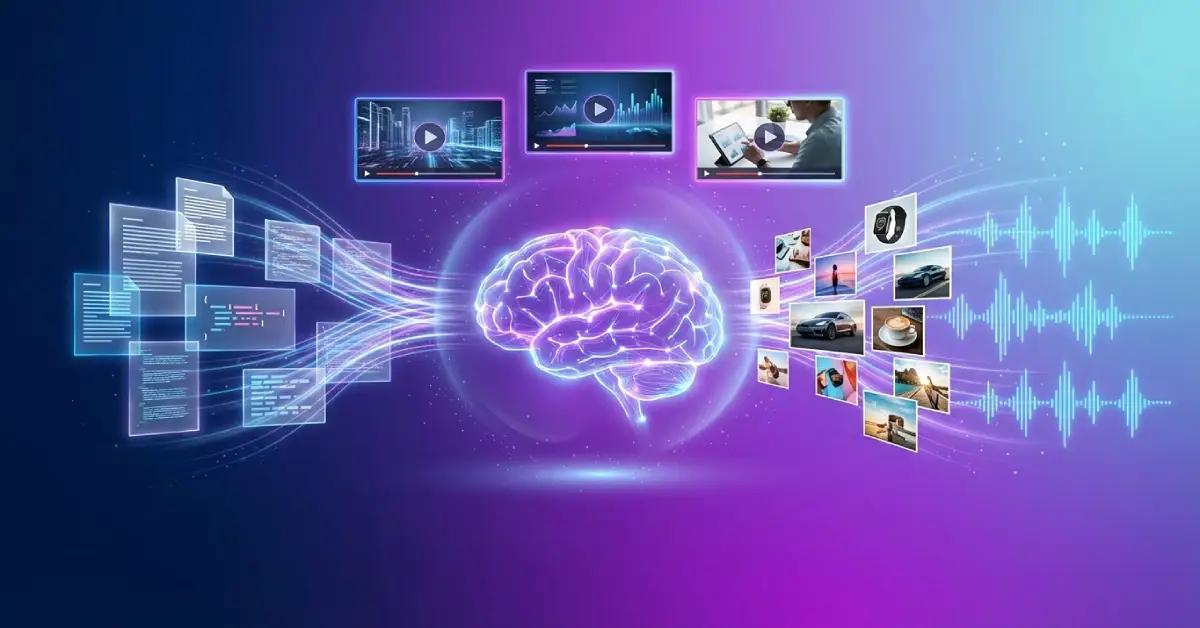
Multimodal AI refers to artificial intelligence systems that can simultaneously process and integrate multiple types of data—including text, images, audio, video, and sensor data—to understand context and generate comprehensive responses. Traditional AI acts like a specialist excelling at one task, while multimodal AI functions more like a human brain by combining information from different sources.
The breakthrough capability lies in cross-modal integration, which allows AI to connect insights across media types. When a system sees a sad face in an image, hears crying in audio, and reads text about loss, it understands the emotional context holistically rather than treating each input separately.
Key components that power multimodal AI systems include advanced computer vision for identifying objects and scenes, natural language processing for understanding text, audio analysis for speech and sound recognition, and most importantly, fusion modules that synthesize insights across all modalities. North America currently dominates the multimodal AI market with an estimated 65.2% share in 2025, driven by strong enterprise adoption and cloud infrastructure.
How Multimodal AI Works
Multimodal AI systems operate through a sophisticated architecture that processes different data types through specialized encoders before merging them into a unified representation.
The processing pipeline starts with separate encoders for each modality. Visual data passes through computer vision models like Vision Transformers, text flows through large language models, and audio processes through speech recognition systems. Each encoder converts its input into numerical representations called embeddings that capture the essential features of that data type.
Fusion modules then combine these separate embeddings into a single, coherent understanding. Modern models use attention mechanisms that let the system focus on the most relevant connections between modalities—for example, linking specific words in a caption to corresponding regions in an image.
The real power emerges in the cross-modal attention layer, where the model learns relationships between different data types. This enables capabilities like generating accurate image descriptions, answering questions about video content, or creating images from text prompts while maintaining contextual understanding across all inputs. Advanced systems like Amazon’s Nova Sonic now integrate speech understanding with generation in a single unified model, eliminating the need for separate transcription and synthesis systems.
Multimodal AI vs Unimodal AI
The fundamental difference between multimodal and unimodal AI lies in data processing capabilities and contextual understanding.
Unimodal AI systems process one data type at a time—text-only chatbots, image-only classifiers, or audio-only speech recognition. While highly specialized, they miss crucial context that comes from combining multiple information sources. A text-only model analyzing customer feedback cannot detect frustration in voice tone or body language captured in video.
Multimodal AI systems process multiple data types simultaneously, creating richer, more nuanced understanding. They can analyze a product review by reading the text, examining attached photos, and even processing video demonstrations—all at once. This comprehensive approach leads to more accurate insights and better decision-making.
In practical terms, multimodal AI reduces the need for multiple separate systems, improves accuracy through cross-validation of different data sources, and enables entirely new capabilities like visual question answering or audio-visual speech recognition that unimodal systems cannot achieve. Organizations implementing multimodal systems report 30-50% faster task completion compared to coordinating multiple unimodal models.
For a detailed technical comparison of architectures and capabilities, see our multimodal vs unimodal AI guide.
Top Multimodal AI Models in 2026
These six models represent the cutting edge of multimodal AI capabilities. For comprehensive analysis including practical implementation and pricing, explore our best multimodal AI models comparison and top multimodal AI tools guides.
Gemini 3 Pro
Google’s Gemini 3 Pro, released November 18, 2025, currently dominates multimodal AI with a record-breaking 1501 Elo score on LMArena—the highest ever recorded. This positions it as the most intelligent model available as we enter 2026.
Gemini 3 Pro achieves 81.0% on MMMU-Pro, creating a 5-point gap ahead of competitors in multimodal understanding and reasoning. Its 87.6% score on Video-MMMU demonstrates exceptional ability to comprehend and synthesize information from dynamic video content, not just static images.
The model’s mathematical prowess is equally impressive, scoring 100% on MATH-500 with code execution and 95.0% without tools—showing robust innate mathematical intuition that makes it less dependent on external tools. On MathArena Apex, one of the hardest reasoning tasks available, Gemini 3 Pro achieves a 20x performance jump over previous models.
Gemini 3 Deep Think, announced as an enhanced reasoning mode, scores 45.1% on ARC-AGI-2 for novel problem-solving. This specialized mode rolled out to Google AI Ultra subscribers in late 2025, further extending the model’s reasoning capabilities for complex analytical tasks.
Claude Opus 4.5
Anthropic released Claude Opus 4.5 on November 24, 2025, introducing breakthrough capabilities for agentic workflows and multimodal understanding. The model represents Anthropic’s best vision model to date, scoring 80.7% on the MMMU benchmark for complex visual interpretation.
Enhanced computer use with a new zoom action enables detailed inspection of specific screen regions at full resolution. This allows Claude to examine fine-grained UI elements, small text, and detailed visual information that might be unclear in standard screenshots—particularly valuable for automating browser-based tasks and analyzing documents with intricate layouts.
The revolutionary effort parameter lets you control how many tokens Claude uses when responding, allowing trade-offs between response thoroughness and token efficiency with a single model. This affects all tokens including text responses, tool calls, and extended thinking, giving developers unprecedented control over cost versus quality.
Opus 4.5 excels at managing teams of subagents, enabling construction of complex, well-coordinated multi-agent systems. In testing, the combination of effort control, context compaction, and advanced tool use boosted Opus 4.5’s performance on deep research evaluations by almost 15 percentage points. The model automatically preserves all previous thinking blocks throughout conversations, maintaining reasoning continuity across extended multi-turn interactions.
GPT-5.2
OpenAI released GPT-5.2 on December 11, 2025, just days ago, responding to what the company internally called a “code red” competitive threat from Google’s Gemini 3 Pro. The update represents a significant leap forward with a 400,000-token context window—double the capacity of GPT-5.1 released just one month earlier.
The model ships in three specialized variants: GPT-5.2 Instant optimized for speed-critical applications, GPT-5.2 Thinking designed for complex reasoning tasks, and GPT-5.2 Pro delivering the highest accuracy for mission-critical use cases. This tiered approach allows developers to optimize for their specific performance versus cost requirements.
Knowledge cutoff advances to August 31, 2025, compared to September 30, 2024 in GPT-5.1, providing significantly fresher information for time-sensitive queries. The model can now generate up to 128,000 tokens in a single response—sufficient for writing entire technical manuals or comprehensive reports without splitting across multiple requests.
Advanced multimodal processing handles images, audio, and video alongside text with integrated reasoning across all modalities in one conversation. GPT-5.2 moves beyond simple object recognition to contextual interpretation across different data types—for example, extracting UI patterns from screenshots and then writing complete test suites, or turning video content into detailed timestamped summaries with action items.
DeepSeek V3.2
DeepSeek launched DeepSeek V3.2 on December 1, 2025, achieving what many considered impossible—gold-medal performance across major international competitions including IMO (International Math Olympiad), CMO (Chinese Math Olympiad), ICPC (programming), and IOI 2025. All while remaining completely free and open-source.
Pricing slashed by 50%+ compared to V3 for API access, though the model remains available for self-hosting at zero marginal cost. The V3.2 release introduces DeepSeek Sparse Attention (DSA), a novel architecture that improves both efficiency and quality by selectively focusing computational resources on the most relevant parts of input sequences.
DeepSeek V3.2-Speciale represents the flagship variant optimized for mathematical and scientific reasoning. The model demonstrates “Thinking in Tool-Use” capability, planning multi-step tool interactions before execution rather than reactively calling functions. This enables more sophisticated automation workflows and reduces errors in complex task execution.
For businesses exploring multimodal AI for business applications, DeepSeek V3.2 eliminates per-token costs while delivering performance that now matches or exceeds commercial alternatives on many benchmarks. The model excels particularly in coding, mathematical reasoning, and scientific analysis—making it ideal for technical users and development teams operating on constrained budgets.
Grok 4.1
xAI released Grok 4.1 on November 17, 2025, following a silent rollout between November 1-14. The update brings substantial improvements in emotional intelligence, creative capabilities, and factual accuracy while addressing hallucination issues that plagued earlier versions.
Grok 4.1 Fast features a massive 2-million token context window—the largest among mainstream commercial models. This enables analysis of entire codebases, comprehensive research paper collections, or extensive documentation sets in a single prompt without chunking or summarization.
The model’s defining feature remains direct access to X (formerly Twitter), providing real-time information capabilities that distinguish Grok from competitors limited to static training data. This integration enables up-to-the-minute insights on trending topics, breaking news, and social sentiment analysis—particularly valuable for marketing teams monitoring brand perception or researchers tracking emerging trends.
Agent Tools API, launched November 19, 2025, enables Grok to natively orchestrate multiple external services, execute code, search databases, and coordinate complex workflows without custom integration code. Strong performance on EQ-Bench3 demonstrates improved emotional intelligence, with the model now better understanding and responding appropriately to sentiment, tone, and social context in conversations.
Amazon Nova Family
Amazon introduced the Nova family in early December 2025, featuring Nova Lite and Nova Pro language models alongside Nova Sonic—a revolutionary real-time voice model. These models became accessible through Amazon Bedrock immediately upon release.
Nova Sonic, launched in October 2025, represents Amazon’s entry into the real-time AI voice race by combining speech understanding with generation in a single unified model. Unlike traditional systems that maintain separate models for listening and speaking, Nova Sonic processes speech end-to-end while preserving tone, pacing, and emotional context.
The model adapts to user emotions in real-time—an angry customer on a support call receives a calm, steady voice in return, while someone sounding excited gets a more upbeat response. This emotional intelligence makes interactions feel genuinely conversational rather than robotic.
Nova Omni, an experimental model, utilizes reasoning across images, audio, video, and text simultaneously for comprehensive multimodal understanding. Meanwhile, Nova Forge lets Amazon customers train frontier models for specific tasks, democratizing access to custom AI development.
Amazon is already using Nova Sonic components internally in products including the newly released Alexa+ voice assistant, demonstrating real-world production readiness. The model currently supports English with multiple voices and accents, with additional language support in development.
Multimodal AI Use Cases for Business
Multimodal AI transforms operations across industries with applications that combine text, images, audio, and video processing. For detailed implementation strategies and ROI data, explore our comprehensive multimodal AI use cases guide.
Customer Support & Service
Multimodal AI transforms customer support by enabling agents to understand issues through text descriptions, product images, screenshots, and voice calls simultaneously. ADT’s AI-driven customer support implementation increased customer satisfaction by 30% and boosted conversions from 44% to 61%.
AI-powered support agents analyze product photos sent by customers, read accompanying text descriptions, and access video tutorials—all while maintaining conversation context. This multimodal approach reduces resolution time by 50% and achieves 90%+ accuracy in understanding complex customer issues.
Bella Santé automated 75% of customer conversations using multimodal AI, generating $66,000 in additional sales while maintaining personalized service. Multimodal systems that detect customer frustration through voice tone and adapt responses accordingly create more empathetic interactions.
Healthcare & Medical Diagnostics
Healthcare organizations leverage multimodal AI to analyze medical images, patient records, lab results, and clinical notes simultaneously for more accurate diagnoses. The technology achieves 95%+ accuracy in data extraction from various medical data formats.
Predictive healthcare systems monitor patients through continuous multimodal analysis of vital signs, imaging data, electronic health records, and wearable device data to identify health risks before they become critical. This preventive approach improves patient outcomes while reducing emergency interventions.
Drug discovery processes benefit from multimodal AI’s ability to analyze molecular structures, research papers, clinical trial data, and genetic information together, accelerating the identification of promising therapeutic candidates.
Content Creation & Marketing
Marketing teams use multimodal AI to generate coordinated campaigns across text, images, and video from a single creative brief. ACI Corporation’s AI implementation in sales operations increased conversions from under 5% to 6.5% while qualified leads jumped from 45.5% to 64.1%.
Automated content workflows now generate blog posts, social media visuals, video scripts, and voiceovers in one seamless process. The technology maintains brand consistency across all outputs while adapting tone and style for different platforms—reducing content production time by 60-70%. Learn step-by-step implementation in AI content creation workflows guide.
Multimodal AI enables personalized marketing at scale by analyzing customer behavior across text interactions, image preferences, video engagement, and voice conversations to deliver hyper-targeted campaigns. For video-specific workflows, our video to blog with AI guide covers transforming video content into written assets efficiently.
E-commerce & Retail
Retail businesses deploy multimodal AI for visual search capabilities that let customers find products by uploading photos, describing items in text, or using voice commands simultaneously. This intuitive search experience reduces browse-to-purchase time by 40% and increases conversion rates significantly.
Automated inventory management systems analyze sales data, supplier communications, warehouse photos, and social media trends to optimize stock levels. Companies achieve 95%+ inventory accuracy while reducing stock-outs by 35% and carrying costs by 20%.
Virtual try-on experiences combine computer vision, text understanding, and augmented reality to let customers see products on themselves before purchasing, reducing return rates by 20-35% while increasing conversion rates.
Financial Services
Insurance companies adopt AI-powered underwriting that analyzes risk profiles through document analysis, image verification, and data pattern recognition with minimal human intervention. This approach increased underwriting efficiency by 50% and improved risk assessment accuracy to 95%+.
Financial advisory automation uses multimodal AI to provide personalized advice by analyzing customer communications, financial documents, market data, and sentiment from voice calls. JPMorgan’s Coach AI achieves 95% faster research retrieval and helped increase asset-management sales by 20% year-over-year.
Payment processing systems leverage multimodal AI to verify transactions through document images, text confirmations, and voice authorizations, processing payments 50% faster with 90%+ accuracy. Organizations implementing end-to-end AI workflows in financial services report up to 210% ROI with payback periods under six months.
Getting Started with Multimodal AI
Choose the Right Model for Your Needs
Start by evaluating your primary use case and required capabilities. For long-context document analysis and research tasks, Gemini 3 Pro with its superior benchmark performance and 1-million token window leads the pack. If you need the freshest information and largest context window, GPT-5.2’s 400,000 tokens with August 2025 knowledge cutoff delivers cutting-edge capability.
Budget considerations matter significantly—while proprietary APIs charge per token, open-source options like DeepSeek V3.2 provide gold-medal performance at zero cost. For voice-specific applications requiring emotional intelligence, Amazon Nova Sonic’s unified speech model delivers natural interactions through Bedrock.
For real-time applications requiring low latency, prioritize models with optimized inference speeds and edge deployment capabilities. Grok 4.1’s 2-million token context with real-time X data access proves ideal for applications requiring up-to-the-minute information on trending topics. Check our comprehensive best multimodal AI models comparison to find the perfect fit for your business needs.
Start with Pre-Built APIs
Most multimodal AI providers offer ready-to-use APIs that require minimal setup. Google’s Gemini API, OpenAI’s GPT-5.2 API, Anthropic’s Claude API, and Amazon Bedrock all provide straightforward endpoints for text, image, audio, and video inputs.
Begin with simple prompts that combine two modalities—for example, analyzing an image with text instructions. Test how the model handles your specific use cases before building complex workflows. Most platforms offer free tiers or trial credits for initial experimentation, with Gemini providing particularly generous limits.
API documentation typically includes code examples in Python, JavaScript, and other popular languages. Start with these samples to understand input formats, response structures, and best practices before customizing for your specific needs. For developer-focused implementation details, our multimodal AI APIs guide covers integration patterns, authentication, rate limits, and best practices.
Design Effective Multimodal Prompts
Craft prompts that clearly specify what information to extract from each modality. Instead of “analyze this image,” try “describe the colors, textures, and layout in this product photo, then suggest marketing copy that highlights these visual elements.”
Provide context about relationships between different inputs. When combining images with text, explain how they connect: “This image shows our product packaging. Based on the visual design and brand colors, revise the following product description to match the premium aesthetic.”
Use descriptive language for visual elements even when uploading images—”describe colors,” “identify patterns,” “compare layouts”—to help the model focus on relevant aspects. Master effective multimodal AI prompts to improve output quality and relevance significantly, especially with newer models like GPT-5.2 and Gemini 3 Pro that excel at contextual interpretation.
Test and Iterate
Run A/B tests comparing different prompt structures, model choices, and input combinations to find what works best for your specific use case. Track key metrics like accuracy, response time, cost per request, and business impact such as conversion rates or time saved.
Monitor for bias and errors especially when dealing with sensitive applications like healthcare or financial services. Implement human review loops for high-stakes decisions even when using AI—the most successful implementations pair AI automation with human oversight for quality and nuanced decision-making.
Scale gradually from proof of concept to production. Start with non-critical workflows, measure ROI using concrete metrics like time saved or accuracy improved, then expand to more complex applications once you’ve validated the approach. Organizations implementing comprehensive AI programs report achieving 210% ROI with payback periods under six months when deployed end-to-end.
Learn how to optimize content for multimodal search as part of your AI strategy to maximize visibility and engagement.
Multimodal AI Trends for 2026
Agentic AI Becomes the Norm
Multimodal AI is evolving beyond simple question-answering into autonomous agents that can reason, plan, and execute multi-step tasks across different modalities. By 2026, multimodality will become the foundation for how AI agents reason continuously rather than responding to isolated prompts.
Built-in tool use capabilities enable AI agents to natively call external APIs, search databases, execute code, and coordinate multiple functions without explicit programming. Gemini 3’s native tool integration, Claude Opus 4.5’s subagent orchestration, and Grok 4.1’s Agent Tools API demonstrate this shift toward self-directed AI assistants.
Businesses are shifting from AI hype to pragmatic implementations, focusing on proven solutions that deliver measurable ROI over novelty features. With 79% of enterprises now using AI in at least one business function, the focus has moved to achieving meaningful productivity gains rather than experimentation.
Real-Time Multimodal Processing
Instant translation with preserved emotional context, cultural nuances, and visual cues is becoming standard in 2026. Systems analyze speaker tone, facial expressions, and gestures simultaneously to deliver translations that capture full meaning beyond literal words.
Live streaming multimodal AI enables real-time analysis of video content, audio streams, and text chat together. Amazon Nova Sonic’s streaming API demonstrates this capability with millisecond-level voice responses that adapt to user emotions mid-conversation.
Edge deployment expands significantly as models become more efficient through techniques like DeepSeek V3.2’s sparse attention architecture, enabling real-time multimodal processing on smartphones, IoT devices, and robotics without cloud dependency. This reduces latency to milliseconds and improves privacy by keeping sensitive data on-device.
Multimodal AI Meets Vertical Specialization
Industry-specific multimodal models trained on domain data will outperform general-purpose models for specialized tasks. Healthcare models will combine medical imaging, clinical notes, and research literature natively, while legal AI will integrate case documents, video depositions, and audio recordings.
Smart cities leverage multimodal AI to optimize urban infrastructure by analyzing traffic patterns from cameras, weather sensor data, social media sentiment, and citizen feedback simultaneously. This comprehensive analysis enables automated adjustments that improve quality of life while reducing operational costs.
Autonomous systems from self-driving vehicles to warehouse robots rely on multimodal AI that processes LIDAR, camera feeds, GPS data, and text-based maps together for robust navigation. The integration of diverse sensor types creates redundancy and improves safety in mission-critical applications.
Enhanced Creative Collaboration
AI creative partners work alongside humans in creative industries, generating original ideas, content, and solutions based on multimodal inputs. These systems understand creative briefs communicated through text, reference images, voice notes, and example videos—then produce coordinated output across all formats.
Personalized education systems adapt to individual students by analyzing attention patterns from webcam data, learning styles from interaction logs, and engagement through voice tone analysis. This multimodal assessment creates truly customized learning paths that improve outcomes by 40-60% compared to traditional approaches.
Emotional intelligence in AI interactions improves dramatically as models like Nova Sonic and Grok 4.1 understand sentiment across voice tone, facial expressions, word choice, and body language captured in video. Customer service agents and healthcare applications particularly benefit from this enhanced empathy, with organizations reporting 30% higher satisfaction scores.
For comprehensive analysis of emerging capabilities and predictions beyond 2026, explore our future of multimodal AI guide.
FAQ
What’s the difference between generative AI and multimodal AI?
Generative AI creates new content like text or images, while multimodal AI processes multiple data types simultaneously. Many modern systems like GPT-5.2, Gemini 3 Pro, and Claude Opus 4.5 are both generative and multimodal—they can understand text plus images as input, then generate multimodal outputs including text, images, and audio. For technical details on how these architectures differ, see our multimodal vs unimodal AI comparison.
Which multimodal AI model is best for small businesses?
DeepSeek V3.2 offers exceptional value for budget-conscious small businesses as a completely free, open-source model with gold-medal performance that now rivals commercial alternatives. For cloud-based solutions, Gemini 3 Pro provides enterprise-grade performance with generous free tiers and cost-efficient pricing. If you need the latest information and largest context, GPT-5.2’s 400,000-token window with August 2025 knowledge delivers cutting-edge capability. For voice-specific applications, Amazon Nova Sonic through Bedrock provides natural interactions with emotional intelligence at competitive rates. Explore implementation strategies in our multimodal AI for business guide.
How much does multimodal AI cost?
Costs vary widely based on usage and provider. Most platforms charge per token processed, with image and audio inputs costing more than text. Typical pricing ranges from $0.05 to $15 per million tokens depending on model capabilities. DeepSeek V3.2 stands out as completely free and open-source with 50%+ lower API pricing than V3, while major providers offer free tiers with monthly allowances sufficient for testing and small-scale use. Enterprise plans often provide volume discounts and can save 40% or more compared to pay-as-you-go pricing. Organizations implementing comprehensive AI programs report achieving 210% ROI with payback periods under six months when deployed end-to-end.
Can multimodal AI run on my own servers?
Yes, with DeepSeek V3.2 leading open-source options for self-hosting. The model requires significant GPU resources—expect multiple high-end GPUs for production performance—but its sparse attention architecture reduces hardware requirements compared to other large models. Self-hosting provides maximum data privacy and eliminates per-token costs at high volumes. For most small businesses, cloud APIs offer better economics unless you have strict data privacy requirements or very high volume that justifies infrastructure investment.
Is multimodal AI safe for handling sensitive data?
Safety depends on implementation approach. Cloud-based APIs process data on provider servers, which may not meet compliance requirements for regulated industries like healthcare and finance. Many providers now offer private endpoints and enterprise agreements with enhanced security guarantees—Amazon Bedrock, Google Vertex AI, and Azure OpenAI Service all provide HIPAA-compliant deployments. For maximum security, consider on-premise deployment of open-source models like DeepSeek V3.2 or edge AI solutions that process data locally. Always review data handling policies, implement encryption, and conduct security audits before processing sensitive information.
What skills do I need to use multimodal AI?
Basic API integration skills suffice for most business applications. If you can make HTTP requests and parse JSON responses, you can use multimodal AI through APIs—no machine learning expertise required. Amazon Nova Sonic’s streaming API and Gemini’s straightforward endpoints make getting started particularly easy. For custom fine-tuning or self-hosted deployment of models like DeepSeek V3.2, you’ll need Python programming skills and familiarity with machine learning frameworks. Many no-code platforms now offer multimodal AI capabilities without any coding required.
How accurate is multimodal AI?
Accuracy varies by task and model. For well-defined tasks like document analysis or image classification, modern multimodal models achieve 90-95%+ accuracy. Gemini 3 Pro leads with 81.0% on MMMU-Pro and 87.6% on Video-MMMU, while Claude Opus 4.5 achieves 80.7% on MMMU and 80.9% on SWE-bench for software engineering. GPT-5.2 delivers strong performance across diverse benchmarks with its three specialized variants optimizing for different accuracy versus speed trade-offs. Always validate outputs for your specific use case rather than relying solely on benchmark scores, as real-world performance depends heavily on prompt quality and task complexity.
Will multimodal AI replace jobs?
Multimodal AI is augmenting rather than replacing most knowledge workers. The technology excels at removing repetitive, low-value work while enabling employees to focus on strategic and creative activities. Financial advisors using AI tools grew client books 50% faster, demonstrating how AI amplifies human capabilities. While most enterprises see 10-15% productivity gains initially, organizations that deploy AI end-to-end across workflows achieve significantly higher returns—some reaching 210% ROI by coordinating multi-step tasks. The most successful implementations pair AI automation with human oversight for quality and nuanced decision-making, creating hybrid workflows that enhance rather than eliminate human roles.