Multimodal AI Use Cases: 15+ Real-World Applications Across Industries
Multimodal AI use cases are transforming how businesses solve complex problems by processing text, images, audio, and video simultaneously rather than treating each data type separately. While traditional AI systems require manual coordination across single-format tools—uploading images to one platform, text to another, combining outputs through tedious workflows—multimodal approaches analyze product photos alongside customer reviews, diagnose medical conditions from radiology scans combined with patient histories, or generate marketing campaigns coordinating visual design with copy tonality in unified processes.
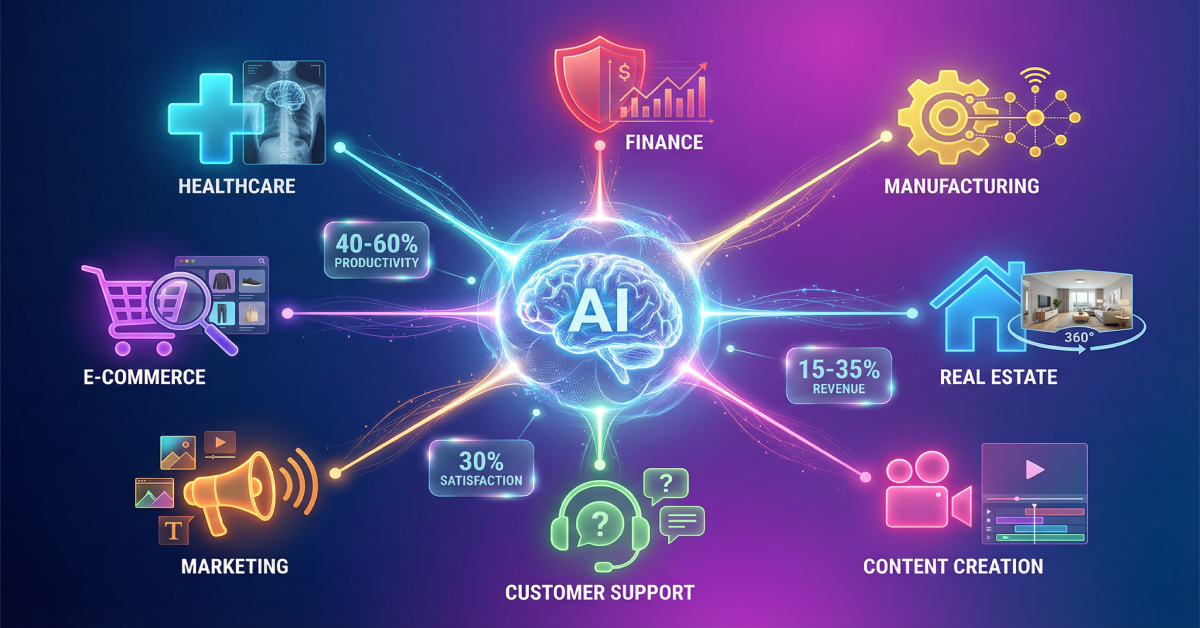
The global multimodal AI market reached $10.89 billion by 2030, driven by organizations achieving measurable ROI through cross-modal understanding impossible with unimodal alternatives. Companies deploying the best multimodal AI models report 40-60% productivity gains, 30% higher customer satisfaction scores, and 15-35% revenue increases across use cases spanning healthcare diagnostics, e-commerce personalization, content creation automation, and customer support enhancement.
This guide examines 15+ proven multimodal AI use cases across eight industries, providing implementation frameworks, ROI benchmarks, and strategic considerations for organizations evaluating where multimodal capabilities deliver competitive advantages versus incremental improvements over existing approaches.
Why Multimodal AI Use Cases Matter
Multimodal AI use cases solve problems that single-format approaches handle poorly or cannot address at all. When radiologists review medical imaging, they don’t examine scans in isolation—they correlate visual findings with patient histories, lab results, genetic data, and clinical notes simultaneously. Traditional AI systems requiring separate models for each data type create integration bottlenecks where critical insights emerge from connections between modalities rather than analysis of individual formats.
Understanding multimodal versus unimodal AI clarifies these architectural advantages. Text-only sentiment analysis of customer feedback misses tone conveyed through voice recordings or frustration visible in support chat screenshots. Image-only product recommendation engines ignore textual preference descriptions that refine visual matching. Video-only content analysis loses captions, audio cues, and on-screen text that provide essential context for comprehension.
The business case for multimodal deployment depends on whether your core processes naturally involve multiple data types requiring coordinated analysis. Customer support teams already collect chat transcripts, call recordings, product photos, and account data—multimodal systems synthesize these inputs into coherent understanding that single-format tools cannot replicate. Marketing teams create campaigns coordinating visual design, copy messaging, video content, and audio elements—multimodal approaches ensure aesthetic and tonal consistency across formats automatically rather than through manual creative direction requiring multiple revision cycles.
Organizations achieving strongest ROI from multimodal use cases share common patterns: high-value decisions currently bottlenecked by manual data synthesis, diverse data types already collected but underutilized, and workflows where cross-format insights directly impact revenue, costs, or customer experience metrics. Evaluate potential use cases against these criteria before investing in multimodal capabilities that may add complexity without proportional value.
Healthcare & Medical Diagnostics
Radiology and Medical Imaging Analysis
Healthcare providers deploy multimodal AI combining radiology scans with electronic health records (EHRs), clinical notes, genetic data, and patient histories for diagnostic support that exceeds capabilities of image-only analysis. IBM Watson Health integrates CT scans, MRI images, pathology reports, and structured clinical data to identify disease patterns, predict patient outcomes, and recommend personalized treatment plans based on comprehensive patient profiles rather than isolated imaging findings.
MIT’s Mirai breast cancer risk model analyzes mammogram images alongside patient demographics, family history, and previous screening results to predict five-year cancer risk with C-index scores of 0.69-0.78 across diverse populations—substantially outperforming traditional risk calculators relying solely on questionnaire data. Personalized screening recommendations based on multimodal risk assessment enable targeted interventions for high-risk patients while reducing unnecessary procedures for low-risk individuals, optimizing both outcomes and healthcare costs.
Viz.ai’s stroke detection platform processes head CT scans combined with patient arrival times, symptom onset data, and hospital workflow information to automatically alert neurologists about suspected large vessel occlusions requiring immediate intervention. Deployed across 1,600+ hospitals, the system reduces time to neurointerventional evaluation by an average of 66 minutes—a critical improvement when brain tissue death accelerates minute-by-minute during acute strokes. The multimodal approach ensures alerts contain complete clinical context enabling immediate triage decisions rather than requiring physicians to manually correlate imaging with scattered electronic records.
Clinical Decision Support and Treatment Planning
Multimodal clinical decision support systems integrate laboratory results, vital signs from monitoring devices, medication histories, and physician notes to flag potential complications, drug interactions, or treatment conflicts that single-source analysis misses. These systems achieve 95%+ accuracy in extracting structured data from diverse formats including handwritten notes, imaging reports, and sensor streams—enabling real-time risk assessment impossible through manual chart review.
Drug discovery platforms combine molecular structures, chemical properties, genomic data, and biomedical literature to identify candidate compounds 50% faster than traditional screening methods. By analyzing protein structures alongside published research describing biological pathways, these systems hypothesize novel therapeutic mechanisms that pure structure-based or literature-based approaches overlook independently.
Implementation Considerations
Healthcare multimodal AI requires rigorous validation across diverse patient populations to ensure algorithmic fairness and avoid bias amplification. Training data must represent demographic diversity matching deployment populations, with regular audits detecting performance degradation for specific subgroups. Regulatory compliance (FDA clearance for clinical use, HIPAA privacy requirements) mandates extensive documentation of model development, validation methodologies, and ongoing monitoring procedures.
Integration with existing EHR systems presents technical challenges as health data exists in inconsistent formats across vendors (Epic, Cerner, Meditech) and specialties. Standardization efforts (FHIR interoperability protocols) facilitate data exchange but require custom mapping and validation for each deployment context.
E-Commerce & Retail
Visual Search and Product Discovery
E-commerce platforms implement multimodal visual search enabling customers to photograph items they like and receive recommendations matching visual aesthetics combined with textual preferences. Amazon’s StyleSnap analyzes uploaded clothing photos using computer vision while processing natural language descriptions like “similar but more casual” or “waterproof version” to refine product suggestions beyond pure visual similarity matching.
Google Lens with Gemini integration supports multimodal shopping queries where users point cameras at furniture while asking “where can I buy this in blue?” The system analyzes visual product characteristics, understands spoken color preference modifications, and returns purchase options from retailers carrying matching items—combining visual recognition, natural language processing, and real-time inventory lookups in unified workflows.
Visual search drives 25-40% higher conversion rates than text-only search for categories where visual appearance matters more than technical specifications—fashion, home decor, furniture, and design-forward consumer products. Customers find relevant products faster through image-based discovery than attempting textual descriptions of visual attributes difficult to articulate precisely.
Personalized Recommendations and Virtual Try-On
Multimodal recommendation engines combine purchase history, browsing behavior, product images, and customer reviews to suggest items matching both demonstrated preferences and stated requirements. By analyzing which product photos customers click alongside review sentiment about fit, quality, or style, these systems infer latent preferences text-only collaborative filtering misses.
Virtual try-on applications overlay product images on customer photos or live video streams, enabling shoppers to visualize clothing fit, furniture placement, or makeup appearance before purchasing. Sephora’s Virtual Artist and IKEA Place apps combine camera input with 3D product models and environmental understanding to render realistic previews reducing return rates 20-35% by improving pre-purchase confidence.
Starbucks deployed multimodal AI analyzing customer app usage, voice orders, purchase patterns, and even local weather data to personalize menu recommendations. The system increased overall ROI 30% and customer engagement 15% by suggesting beverages matching both individual taste profiles and contextual factors like temperature or time of day—connections pure purchase history analysis overlooks.
Inventory and Supply Chain Optimization
Retailers use multimodal AI combining sales data, social media trend analysis, weather forecasts, and local event calendars to predict demand patterns across thousands of SKUs and locations. H&M’s inventory management system reduced support costs while increasing sales revenue by automatically adjusting stock levels based on real-time signals spanning multiple data sources that influence purchasing behavior.
Visual quality control systems in warehouses and fulfillment centers process product images alongside sensor data detecting packaging defects, incorrect item picks, or damaged goods before shipping. These systems achieve 98%+ accuracy identifying issues that manual inspection catches only 85-90% of the time, reducing customer complaints and return processing costs.
Marketing & Advertising
Creative Development and Brand Consistency
Marketing teams deploy multimodal AI analyzing brand guidelines (logos, color palettes, typography specifications) alongside existing campaign assets to generate new creative materials maintaining visual and tonal consistency automatically. Rather than requiring designers to manually reference style guides when producing ads, social posts, or email templates, AI systems enforce brand standards while adapting creative approaches to platform-specific requirements and audience preferences.
Competitive analysis tools process competitor advertising creatives (images, videos, copy) across channels to reverse-engineer messaging strategies, visual themes, and psychological triggers driving engagement. Marketers generate differentiated campaigns incorporating successful elements from competitive analysis while maintaining brand distinctiveness—accelerating creative development cycles from weeks to days.
Content Personalization and Campaign Optimization
Dynamic content generation systems create personalized ad variations combining product images with copy tailored to audience segments inferred from browsing behavior, demographic data, and engagement patterns. Instead of manually crafting separate creatives for each target group, multimodal AI generates hundreds of variations testing different visual-textual combinations to identify highest-performing approaches through automated A/B testing.
ACI Corporation implemented multimodal AI in sales operations, improving conversion rates from under 5% to 6.5% while increasing qualified lead percentage from 45.5% to 64.1%. The system analyzed sales call transcripts, CRM data, email interactions, and proposal documents to identify patterns distinguishing successful deals from losses—insights informing both individual rep coaching and systemic process improvements.
Social Media Management and Monitoring
Social listening platforms combine text analysis of mentions and comments with image recognition detecting logo appearances and sentiment analysis of video content to provide comprehensive brand monitoring across channels. By processing visual contexts surrounding brand mentions—product photos, user-generated content, influencer posts—these systems surface insights that text-only monitoring misses entirely.
Automated content repurposing tools transform long-form content like webinars or podcasts into platform-optimized formats—extracting key quotes for Twitter, generating carousel graphics for Instagram, creating short video clips for TikTok, and drafting LinkedIn articles—all while maintaining messaging consistency and brand voice across diverse formats.
Customer Support & Success
Intelligent Ticket Routing and Issue Resolution
Customer support platforms analyze support tickets combining text descriptions, attached photos or screenshots, account histories, and product usage data to automatically route inquiries to specialists with relevant expertise and provide agents with comprehensive context before customer interactions begin. This multimodal triage reduces average handling time 25-40% by eliminating the information gathering phase where agents manually search multiple systems reconstructing customer situations.
When customers submit product damage claims with photos, multimodal AI assesses visual evidence alongside purchase records, shipping data, and similar past claims to recommend resolution pathways—full replacement, partial refund, troubleshooting guidance—accelerating decisions that previously required manual review by specialized teams. Legitimate claims resolve 50%+ faster while flagging fraudulent submissions with 95%+ accuracy based on visual inconsistencies or pattern anomalies.
Virtual Assistants and Conversational AI
Bank of America’s Erica virtual assistant handles over one billion interactions by combining voice recognition, text chat, account data analysis, and transaction histories to resolve customer requests spanning balance inquiries, bill payments, financial advice, and fraud alerts. The multimodal approach enables natural conversations where customers switch freely between typing, speaking, and sharing screenshots while the assistant maintains context across interaction modes.
Healthcare providers deploy multimodal triage systems analyzing patient voice calls, text descriptions, medical histories, and even facial expression analysis during video consultations to assess urgency and direct patients to appropriate care pathways. By detecting stress indicators across multiple signals, these systems prioritize truly urgent cases while efficiently routing routine inquiries to self-service resources or scheduled appointments.
Self-Service Knowledge Bases
Automated documentation generation tools create user guides by processing software interface screenshots, recorded demonstrations, and existing help articles to produce comprehensive step-by-step instructions with annotated visuals. These systems reduce documentation development time 60-70% while ensuring consistency between visual examples and textual explanations that manual authoring often misses.
Content Creation & Media
Video Production and Editing
Multimodal video creation platforms combine script analysis, automated image generation, voice synthesis, and intelligent editing to produce professional videos from text descriptions. Tools using multimodal AI prompts transform blog posts into video scripts, generate relevant b-roll imagery, select appropriate background music matching content tone, and synchronize visual transitions with narrative pacing—compressing production timelines from days to hours.
Automated video repurposing extracts highlights from long-form content like webinars or podcasts, generating short clips optimized for social platforms with automated captions, thumbnail generation, and platform-specific aspect ratio adjustments. Content teams multiply distribution reach without proportional production investment, maximizing ROI from primary content creation efforts.
Blog and Article Generation
Content systems analyze topic briefs, reference materials (PDFs, competitor articles, research papers), and brand voice examples to generate comprehensive blog posts incorporating relevant statistics, expert quotes, and strategic internal linking. By processing diverse source materials simultaneously rather than requiring writers to manually synthesize research, these tools accelerate first-draft production while maintaining factual accuracy and stylistic consistency.
Image and Design Generation
Marketing asset creation tools generate branded graphics, social media visuals, and ad creatives from text descriptions while respecting brand guidelines automatically. Instead of briefing designers with potentially ambiguous verbal requests, marketers describe desired concepts and receive options incorporating approved colors, typography, and compositional styles—reducing revision cycles while maintaining professional quality standards.
Education & Training
Adaptive Learning Systems
Educational platforms analyze student performance across multiple assessment types—quizzes, written assignments, video presentations, discussion participation—to identify knowledge gaps and personalize learning paths. By processing both objective performance metrics and subjective communication patterns, these systems detect comprehension issues that single-format assessment misses.
Multimodal learning simulators combine visual environments, spoken instructions, gesture recognition, and eye-tracking to create immersive training scenarios for complex skills like surgical procedures, equipment operation, or emergency response. Learner attention patterns, stress indicators from facial analysis, and performance metrics inform real-time adaptive difficulty adjustments optimizing skill acquisition rates.
Content Accessibility
Automated accessibility tools generate image descriptions for visually impaired learners, create video captions for deaf students, and produce simplified explanations of complex visual concepts—transforming educational materials into formats accommodating diverse learning needs without manual adaptation for each accessibility requirement.
Real Estate & Architecture
Property Marketing and Virtual Tours
Real estate agents use multimodal AI analyzing property photos to generate compelling listing descriptions highlighting unique features visible in images—architectural details, natural lighting, spatial qualities—that generic text templates miss. Combined with neighborhood context (local amenities, school ratings, walkability scores), these systems create comprehensive marketing materials from visual inputs in minutes rather than requiring agents to manually craft descriptions for each listing.
Virtual tour platforms combine 360-degree photography with floor plans, property documents, and neighborhood data to create interactive experiences enabling remote property exploration. Buyers tour homes, overlay furniture visualizations, and access detailed specifications without physical visits—accelerating decision timelines while expanding market reach beyond local buyers to remote purchasers.
Design and Planning
Architectural visualization tools transform blueprints and CAD files into photorealistic renderings showing how spaces will appear with different finishes, lighting conditions, or furniture arrangements. Clients visualize design options comprehensively before construction begins, reducing costly mid-project changes from misaligned expectations.
Manufacturing & Industrial
Predictive Maintenance
Manufacturing operations deploy multimodal monitoring systems combining vibration sensors, thermal imaging, acoustic analysis, and operational logs to predict equipment failures before breakdowns occur. Siemens’ predictive maintenance platform analyzes sensor data streams alongside maintenance histories and production schedules to recommend optimal intervention timing—minimizing unplanned downtime while avoiding unnecessary preventive maintenance on healthy equipment.
These systems detect failure patterns invisible to single-sensor monitoring by correlating subtle changes across multiple signals. A bearing developing microscopic cracks might show minimal vibration changes individually detectable, but when combined with slight temperature increases and ultrasonic noise pattern shifts, multimodal analysis flags imminent failure days or weeks before catastrophic breakdown.
Quality Control and Defect Detection
Vision systems combined with acoustic sensors identify product defects by analyzing visual appearance alongside sounds during operation. Manufacturing lines processing complex assemblies use multimodal inspection detecting issues that pure visual analysis misses—internal component misalignment audible through acoustic analysis but not visible externally, or micro-cracks detectable through thermal imaging showing abnormal heat dissipation patterns.
Financial Services
Fraud Detection and Risk Assessment
Financial institutions analyze transaction patterns, device fingerprints, biometric authentication signals, and communication metadata to detect fraudulent activity with 98%+ accuracy while minimizing false positives that frustrate legitimate customers. Multimodal fraud systems identify sophisticated attacks coordinating stolen credentials with device spoofing and behavioral mimicry by detecting subtle inconsistencies across multiple verification signals.
Automated Underwriting
Insurance companies use multimodal underwriting analyzing risk profiles from structured application data, unstructured documents (medical records, inspection reports), property images, and third-party data sources to make coverage decisions with minimal manual review. These systems achieve 95%+ accuracy in data extraction while reducing policy issuance timelines 50-70%—improving customer experience through faster approvals while maintaining underwriting quality.
JPMorgan’s Coach AI assists wealth advisors by retrieving research in seconds, anticipating client questions based on portfolio holdings and market conditions, and suggesting next-best actions during volatility. The system increased asset-management sales 20% year-over-year while enabling advisors to potentially grow client books 50% faster by automating routine research and administrative tasks.
Choosing the Right Multimodal AI Use Case
Assess Cross-Modal Value
The strongest multimodal AI use cases involve processes where insights emerge from connections between data types rather than analysis of individual formats independently. Customer support resolving visual product issues, medical diagnosis correlating imaging with patient histories, or marketing ensuring creative consistency across channels all benefit dramatically from unified multimodal analysis versus coordinating separate single-format tools through manual workflows.
Conversely, use cases processing primarily single-format data with occasional cross-format references gain less from multimodal complexity. Text-heavy document analysis occasionally referencing charts benefits more from strong language models with basic image recognition than full multimodal architectures designed for tightly integrated cross-format reasoning.
Evaluate Implementation Readiness
Successful multimodal deployment requires data infrastructure collecting and storing diverse formats in accessible locations with consistent metadata enabling model training and inference. Organizations lacking centralized data repositories, standardized file formats, or quality control processes ensuring usable training data face substantial preparatory work before realizing multimodal benefits.
Technical expertise matters significantly—multimodal systems require specialized knowledge spanning computer vision, natural language processing, audio analysis, and system integration that exceeds requirements for single-format AI deployment. Teams lacking this expertise need external partnerships, vendor solutions, or substantial training investments before attempting custom multimodal development.
Calculate ROI Potential
Prioritize use cases where multimodal capabilities directly impact measurable business metrics—revenue, costs, customer satisfaction, operational efficiency. Quantify current process costs (labor hours, error rates, cycle times) and estimate improvement potential from multimodal automation or augmentation to build business cases justifying implementation investments.
Organizations achieving strongest returns deploy multimodal AI where manual workflows currently bottleneck high-value activities. Radiologists spending hours correlating imaging with records, support agents manually searching multiple systems reconstructing customer contexts, or marketers coordinating creative assets across teams all represent opportunities where multimodal automation delivers substantial productivity gains translating directly to capacity increases or cost reductions.
Start with Proven Use Cases
Early multimodal projects benefit from selecting well-documented use cases with established success patterns rather than attempting novel applications requiring extensive experimentation. Visual search for e-commerce, medical image analysis, or customer support automation all have mature solution providers, reference architectures, and documented ROI benchmarks reducing implementation risk.
Once organizational capabilities mature through successful initial deployments, expand to more specialized use cases leveraging lessons learned about data preparation, model optimization, and change management from foundational projects.
Implementing Multimodal AI Successfully
Data Preparation and Quality
Multimodal model performance depends critically on training data quality across all modalities. Inconsistent image resolutions, incomplete metadata, or poorly aligned cross-format annotations degrade model accuracy substantially. Invest in data cleaning, standardization, and validation processes ensuring training datasets represent production conditions and use case requirements accurately.
Synthetic data generation helps address gaps in training coverage, but validate synthetic examples against real-world distributions avoiding model biases toward artificial patterns. Balance synthetic augmentation with sufficient authentic examples ensuring models generalize to production conditions rather than overfitting to training artifacts.
Model Selection and Customization
Leverage pre-trained foundation models like Gemini 3 Pro, GPT-5.2, or Claude Opus 4.5 for general use cases where commercial solutions provide sufficient accuracy without custom development. These models handle common multimodal tasks—image analysis with textual descriptions, document understanding, video summarization—effectively out-of-box with minimal configuration.
Specialized use cases requiring domain-specific understanding benefit from fine-tuning open-source models on proprietary data. Medical imaging, legal document analysis, or industrial quality control all involve terminology, visual patterns, and domain knowledge that general-purpose models lack. Organizations with sufficient technical capacity and training data achieve better results through customization than attempting to prompt-engineer general models toward specialized requirements.
Integration and Workflow Design
Multimodal AI delivers maximum value when integrated seamlessly into existing workflows rather than requiring users to adopt separate tools or processes. Customer support agents reviewing tickets with embedded AI insights, radiologists accessing diagnostic suggestions within PACS systems, or marketers generating assets directly from campaign management platforms all represent workflow-integrated deployments maximizing adoption and impact.
API-based architectures enable modular integration where multimodal capabilities augment existing systems through well-defined interfaces. This approach reduces migration risk and enables incremental rollout testing impacts before full-scale deployment commits organizations to new platforms.
Change Management and Training
Successful multimodal deployment requires user training emphasizing how AI augments rather than replaces human judgment. Healthcare providers need confidence understanding when to trust AI suggestions versus seeking second opinions, customer support agents need frameworks for validating AI recommendations before applying resolutions, and creative teams need guidance refining AI-generated assets to meet brand standards.
Pilot programs with early adopters build organizational expertise and identify workflow friction points before broader rollout. Document lessons learned, optimize processes based on pilot feedback, and leverage early success stories building enthusiasm for wider adoption.
FAQ
What are the most common multimodal AI use cases?
The most common multimodal AI use cases include customer support (analyzing chat transcripts, product photos, and account data for faster resolution), e-commerce visual search (combining product images with text descriptions for personalized recommendations), healthcare diagnostics (correlating medical imaging with patient histories and lab results), content creation (generating videos from scripts with relevant visuals and audio), and marketing (ensuring brand consistency across text, image, and video assets). These use cases achieve widespread adoption because they solve high-value problems where insights emerge from connections between multiple data types rather than analysis of individual formats independently. Organizations report 40-60% productivity gains and 15-35% revenue increases from these applications.
How much does multimodal AI implementation cost?
Multimodal AI implementation costs vary dramatically based on approach. API-based solutions using commercial models (Gemini 3 Pro, GPT-5.2, Claude Opus 4.5) start at $100-1,000 monthly for small-scale deployments (1,000-10,000 queries) and scale to $5,000-50,000+ monthly for enterprise volumes. Custom development requires $50,000-500,000+ initial investment for data preparation, model training, and system integration, plus ongoing maintenance costs. Organizations with 500,000+ monthly queries often find self-hosting open-source models (Llama 4 Scout, DeepSeek V3.1) more cost-effective despite $10,000-100,000 infrastructure investments. Total cost of ownership includes compute resources, data storage, technical personnel, and change management—not just model access fees.
Which industries benefit most from multimodal AI?
Healthcare, e-commerce, financial services, manufacturing, and media/entertainment derive strongest multimodal AI benefits due to processes naturally involving diverse data types requiring coordinated analysis. Healthcare correlates imaging with patient records, e-commerce combines product visuals with purchase behavior, financial services analyzes transaction patterns with biometric authentication, manufacturing monitors equipment through sensors and cameras, and media creates content coordinating text, images, audio, and video. These industries achieve measurable ROI through improved diagnostic accuracy (healthcare), higher conversion rates (e-commerce), reduced fraud losses (finance), decreased downtime (manufacturing), and faster content production (media). Industries processing primarily single-format data see less dramatic benefits unless specific use cases involve substantial cross-format requirements.
What’s the difference between multimodal AI and traditional AI?
Multimodal AI processes multiple data types (text, images, audio, video) simultaneously within unified models, whereas traditional AI typically handles single formats through separate specialized systems. Traditional approaches require manual coordination when tasks involve multiple formats—uploading images to vision models, text to language models, then manually synthesizing outputs. Multimodal systems analyze cross-format relationships directly, detecting patterns like visual-textual inconsistencies, tone matching between images and copy, or correlations between spoken sentiment and facial expressions that separate single-format tools miss. This architectural difference enables use cases impossible with traditional AI, such as generating marketing campaigns maintaining aesthetic consistency across text and visuals, or diagnosing medical conditions by correlating imaging findings with patient histories automatically.
How do I choose between building custom vs using pre-built multimodal AI?
Choose pre-built multimodal AI solutions (Gemini 3 Pro, GPT-5.2, Claude Opus 4.5) for general use cases where commercial models provide sufficient accuracy without domain-specific customization—customer support, content creation, basic image analysis, document understanding. These solutions offer faster deployment, lower technical complexity, and predictable costs suitable for most organizations. Build custom solutions when use cases require specialized knowledge unavailable in general models (medical imaging interpretation, legal document analysis, proprietary product recognition), your organization possesses substantial training data and technical expertise, or data sovereignty requirements prevent cloud-based API usage. Custom development costs 5-50x more than commercial solutions but delivers superior performance for highly specialized applications where general-purpose models underperform.
What data do I need to implement multimodal AI?
Successful multimodal AI implementation requires training data representing all formats your use case processes—images, text, audio, video—with consistent quality, accurate labels, and aligned cross-format annotations. For customer support, collect historical tickets including chat transcripts, call recordings, uploaded photos, and resolution outcomes. For medical diagnostics, gather imaging studies paired with corresponding clinical notes, lab results, and diagnoses. Data volumes depend on complexity—general use cases work with thousands of examples, while specialized domains require tens of thousands for acceptable accuracy. Synthetic data augmentation extends limited datasets but validate performance on authentic examples ensuring models generalize to production conditions. Organizations lacking adequate training data should start with pre-trained commercial models requiring minimal customization rather than attempting custom development.
How long does multimodal AI implementation take?
Multimodal AI implementation timelines range from weeks to months depending on approach. API-based commercial solutions deploy in 2-8 weeks including requirements definition, data preparation, integration development, and user training. Custom model development requires 3-12 months spanning data collection and labeling, model architecture selection, training and validation, integration implementation, and pilot testing. Organizations starting with proven use cases and existing data infrastructure achieve faster deployments than those requiring substantial data preparation or novel application development. Phased rollouts starting with pilot programs in controlled environments reduce risk while building organizational expertise before enterprise-wide deployment commits resources to unproven approaches.
Can small businesses benefit from multimodal AI?
Small businesses benefit from multimodal AI through accessible commercial solutions requiring minimal technical expertise and capital investment. Customer support platforms, e-commerce visual search tools, and content creation assistants offer subscription-based pricing ($30-500/month) providing multimodal capabilities without custom development costs. Small retailers use visual search improving product discovery, service businesses deploy chatbots handling text and image inputs for customer inquiries, and content creators leverage automated video production accelerating output. ROI comes from productivity gains (40-60% faster workflows) and improved customer experiences (15-30% higher satisfaction) rather than massive scale. Small businesses should prioritize proven use cases with established solution providers rather than attempting custom development requiring expertise and resources beyond typical small business capabilities.
These 15+ multimodal AI use cases demonstrate how organizations across industries leverage cross-format intelligence to solve problems impossible with traditional single-format approaches. As you evaluate opportunities for your organization, focus on use cases where insights emerge from connections between data types, where existing workflows already collect diverse formats, and where multimodal automation directly impacts measurable business outcomes. Success comes from matching use case selection to organizational readiness, starting with proven applications before expanding to more specialized deployments as capabilities mature.