
Multimodal vs Unimodal AI: What’s the Difference?
Multimodal vs unimodal AI represents one of the most consequential technology decisions businesses face in 2026. While multimodal systems like GPT-5.2 and Gemini 3 Pro capture headlines with their ability to process text, images, and audio simultaneously, unimodal AI quietly powers billions of specialized applications—from medical imaging diagnostics to voice transcription services—with laser-focused precision.
The distinction matters more than ever as organizations allocate AI budgets and plan digital transformation initiatives. Multimodal AI delivers 30-50% faster task completion when context spans multiple data types, but requires significantly more computational resources and training data. Unimodal AI excels at specific, well-defined tasks with simpler architectures and lower implementation costs, making it the pragmatic choice for many business applications.
This guide breaks down the fundamental differences in this AI comparison, when to use each approach, and how to make strategic decisions that align AI capabilities with actual business needs rather than technology trends.
What is Unimodal AI
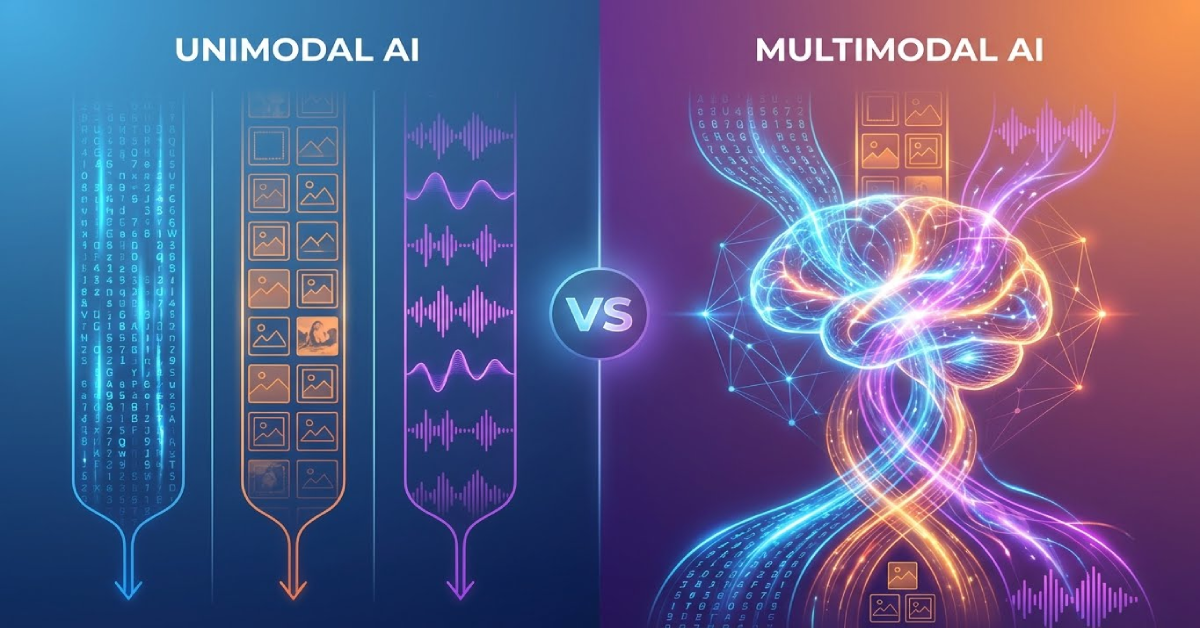
Unimodal AI processes one type of data at a time—exclusively text, exclusively images, exclusively audio, or exclusively numerical data. These systems specialize in their chosen modality, developing deep expertise within that single domain without attempting to bridge across different data formats.
A text-only chatbot that answers customer questions represents classic unimodal AI. It reads written queries and generates text responses, operating entirely within the linguistic domain. Image classification systems that categorize product photos into predefined categories exemplify visual unimodal AI—they analyze pixels and shapes without processing accompanying text descriptions or audio metadata.
The defining characteristic is data type exclusivity. Unimodal models cannot natively combine information across formats—they won’t correlate a customer’s frustrated tone in a voice call with their written complaint history, or connect product images with textual reviews. This specialization creates both limitations and advantages depending on the use case.
Traditional unimodal systems require massive amounts of their specific data type to achieve high accuracy. A speech recognition model needs thousands of hours of audio transcriptions, while a medical imaging classifier demands tens of thousands of labeled X-rays or MRI scans. This data intensity within a single modality contrasts with multimodal AI models that can leverage smaller datasets across multiple formats.
What is Multimodal AI
Multimodal AI processes and integrates multiple data types simultaneously—combining text, images, audio, video, and sensor data to form comprehensive understanding. Rather than analyzing inputs in isolation, these systems connect insights across formats to mirror how humans naturally perceive the world through multiple senses.
When you upload a product photo to GPT-5.2 and ask “Where can I buy this?”, the system analyzes the visual to identify the product, processes your written question to understand intent, and potentially considers your location data to suggest nearby retailers—all in a single integrated inference. This cross-modal reasoning fundamentally differs from coordinating separate unimodal systems that each handle one aspect independently.
Modern multimodal AI systems use fusion architectures that process each data type through specialized encoders, then merge these representations in a unified semantic space where relationships between modalities become apparent. When analyzing a restaurant review, the AI simultaneously considers the written text, attached food photos, ambient sounds in a video walkthrough, and star ratings—synthesizing these diverse signals into holistic understanding.
The breakthrough capability lies in cross-modal validation and enrichment. If someone posts “This beach is beautiful” with an image of a polluted shoreline, multimodal AI detects the contradiction between textual sentiment and visual reality—catching sarcasm or mismatched information that unimodal text analysis would miss. This contextual depth explains why organizations implementing multimodal systems report 30-50% faster task completion compared to coordinating multiple unimodal models for complex workflows.
Multimodal vs Unimodal AI: Key Differences
Data Processing Approach
Unimodal AI consumes a single data stream through specialized processing pipelines optimized for that specific format. Text models use transformers with attention mechanisms tuned for language patterns, while image models employ convolutional neural networks designed for spatial feature extraction. Each pipeline develops deep expertise within its modality but cannot natively interpret other formats.
Multimodal AI operates through parallel processing streams that convert different data types into compatible representations before fusion. Text passes through language encoders, images through vision transformers, and audio through speech processors—then these separate encodings merge in shared embedding spaces where cross-modal relationships become mathematically comparable and analyzable.
Contextual Understanding
Unimodal systems interpret context solely within their data type. A text-only customer service bot understands conversational context from previous messages but cannot detect frustration in voice tone or identify damaged products from uploaded photos. This single-channel context works well when all relevant information exists in one format but misses signals from other sources.
Multimodal AI builds context by synthesizing information across formats. When analyzing customer complaints, multimodal systems combine written descriptions, product photos showing damage, voice recordings capturing emotional state, and historical purchase data—creating multi-dimensional understanding that surfaces issues invisible to single-modality analysis.
Accuracy and Performance
For narrowly defined tasks within a single modality, unimodal AI often achieves higher accuracy than multimodal alternatives due to architectural specialization. A dedicated medical imaging classifier analyzing X-rays can outperform a general-purpose multimodal system on that specific visual task because every parameter optimizes for that one function.
Multimodal AI delivers superior accuracy on tasks requiring information synthesis across formats. Visual Question Answering tasks where systems answer questions about images see multimodal models achieving 90%+ accuracy compared to 60-70% for unimodal approaches that process images and text separately. The cross-validation between modalities reduces errors and ambiguity that plague single-format analysis.
Implementation Complexity
Unimodal systems feature simpler architectures with fewer components to integrate, debug, and maintain. A voice transcription service follows a straightforward pipeline: audio input → feature extraction → sequence modeling → text output. Fewer moving parts mean faster development cycles and easier troubleshooting when issues arise.
Multimodal systems require complex architectures coordinating multiple encoders, fusion mechanisms, and alignment strategies to ensure different data types synchronize properly. Training demands paired data where images correspond to captions, audio aligns with transcripts, and videos match descriptions—significantly harder to collect than single-modality datasets.
Resource Requirements
Training unimodal models demands substantial data within their specific format but can run on more modest hardware compared to multimodal alternatives. A text classifier might train effectively on a single high-end GPU, while image models require multiple GPUs but still less infrastructure than multimodal systems processing several formats simultaneously.
Multimodal AI consumes significantly more computational resources during both training and inference. Processing video, analyzing frames, extracting audio, and running text recognition in parallel requires powerful GPU clusters or specialized AI accelerators. Cloud API costs for multimodal models like GPT-5.2 typically run 3-5x higher per request than text-only alternatives due to this computational intensity.
Comparison Table
| Dimension | Unimodal AI | Multimodal AI |
|---|---|---|
| Data Types | One format (text OR image OR audio) | Multiple formats simultaneously |
| Context Understanding | Single-modality context only | Cross-format context synthesis |
| Task Suitability | Specialized, narrow applications | Complex, context-rich scenarios |
| Accuracy | Higher for format-specific tasks | Higher for cross-modal understanding |
| Architecture | Simpler, focused pipelines | Complex fusion mechanisms |
| Training Data | Large volumes of one type | Smaller amounts across multiple types |
| Development Time | Faster implementation cycles | Longer development timelines |
| Resource Costs | Lower computational requirements | Higher GPU and API costs |
| Flexibility | Limited to trained format | Adapts across data types |
| Maintenance | Easier debugging and updates | More complex troubleshooting |
When to Use Unimodal AI
Specialized Domain Tasks
Unimodal AI excels when the problem space naturally exists within a single data format. Medical image classification for identifying pneumonia or tumors in X-rays operates exclusively on visual data—adding audio or text processing wouldn’t improve diagnostic accuracy and would introduce unnecessary complexity.
Natural language processing tasks like sentiment analysis of customer reviews, legal document summarization, or email categorization work entirely with text. These applications achieve 85-95% accuracy using specialized large language models without requiring visual or audio components that add cost without value.
Budget-Constrained Projects
Organizations with limited AI budgets benefit from unimodal approaches that deliver results at lower costs. A text-only customer service chatbot handling frequently asked questions can run on modest infrastructure costing $200-500 monthly compared to $2,000-5,000 for multimodal systems with image and voice capabilities.
Startups and small businesses exploring AI for small business applications often start with unimodal solutions that prove value before investing in more complex multimodal infrastructure. This staged approach minimizes financial risk while building internal AI expertise progressively.
Real-Time Processing Requirements
Applications demanding millisecond-level responses favor unimodal architectures with simpler processing pipelines. Voice transcription services converting speech to text in real-time, fraud detection systems analyzing transaction patterns, or recommendation engines suggesting products based on browsing history—all benefit from the speed advantages of specialized single-format processing.
Multimodal systems processing multiple data streams in parallel introduce latency that makes them unsuitable for time-critical applications. When speed matters more than comprehensive context, unimodal AI delivers faster results with lower computational overhead.
Regulatory Compliance Scenarios
Industries with strict data handling regulations sometimes prefer unimodal approaches that limit data exposure. A healthcare provider using AI for appointment scheduling through text-only interfaces avoids privacy complications of processing voice recordings or patient photos that carry higher regulatory burdens under HIPAA.
Financial services firms implementing fraud detection on transaction data alone sidestep complexities of biometric data processing or video surveillance analysis that trigger additional compliance requirements and audit procedures. This AI comparison shows unimodal systems often simplify regulatory compliance.
Limited Technical Expertise
Teams without extensive AI engineering experience find unimodal systems easier to implement, debug, and maintain. Pre-trained text models available through simple APIs require minimal customization compared to multimodal systems demanding expertise in computer vision, speech processing, and cross-modal fusion simultaneously.
Organizations can deploy effective unimodal solutions with one or two specialists, while multimodal projects typically require diverse teams spanning multiple AI disciplines—increasing both payroll costs and coordination overhead.
When to Use Multimodal AI
Complex Decision-Making Scenarios
Business problems requiring synthesis of diverse information sources demand multimodal approaches. Insurance claims processing that evaluates accident photos, police reports, medical records, and claimant interviews benefits from integrated analysis across visual, textual, and audio formats that reveals inconsistencies invisible to single-format review.
Supply chain risk assessment combining satellite imagery showing weather patterns, text reports on geopolitical developments, sensor data from logistics networks, and financial market indicators creates comprehensive situational awareness impossible through unimodal analysis of any single data stream. Understanding when to use multimodal AI starts with identifying these complex synthesis requirements.
Customer Experience Enhancement
Modern customer expectations favor natural interactions across multiple channels. AI customer support solutions that handle text chat, voice calls, and image uploads of product issues within a single conversation create seamless experiences that increase satisfaction by 30-40% compared to forcing customers into separate channels for different problem types.
E-commerce platforms using multimodal AI to enable visual search—uploading product photos while adding text descriptions of desired features—convert 25-35% better than text-only search because they match how customers naturally shop and describe what they want.
Content Creation at Scale
Organizations producing diverse content benefit from multimodal systems that coordinate text, images, and video generation. Marketing teams using content creation workflows powered by models like GPT-5.2 generate blog posts with relevant visuals, social media content with appropriate imagery, and video scripts with scene descriptions—all from a single creative brief rather than separate tools for each format.
News organizations employ multimodal AI to automatically generate article text, select relevant images from archives, create video summaries, and produce audio versions—expanding content distribution across formats without proportionally scaling staff.
Quality Control and Inspection
Manufacturing quality control combining visual inspection of products, sensor readings from production equipment, and text logs of machine performance detects defects 40-50% more reliably than vision-only systems. The cross-validation between visual anomalies and performance data reduces false positives that plague single-modality inspection.
Food safety applications analyzing product appearance, smell (through electronic noses), and production records simultaneously achieve 95%+ accuracy in contamination detection compared to 70-80% for visual inspection alone—directly impacting consumer safety and brand protection.
Autonomous Systems
Self-driving vehicles represent quintessential multimodal applications that fuse camera feeds, LIDAR point clouds, radar signals, GPS data, and text-based map information to navigate safely. No single data source provides sufficient context—visual cameras struggle in fog, LIDAR fails on dark surfaces, GPS drifts in urban canyons—so multiple modalities working together create redundancy and reliability.
Warehouse robots similarly combine vision for object recognition, depth sensors for navigation, audio cues for human presence detection, and text-based inventory databases to safely and efficiently move goods without colliding with people or mishandling packages.
Accessibility Requirements
Organizations committed to inclusive design leverage multimodal AI to serve users with different abilities. Video conferencing tools that provide real-time transcription (speech-to-text), sign language interpretation (vision processing), and tone-adjusted audio (speech processing) ensure participation regardless of hearing, vision, or cognitive differences.
Educational platforms using multimodal approaches that present information through text, audio, images, and interactive simulations accommodate diverse learning styles and accessibility needs—improving comprehension by 25-40% compared to single-format instruction.
Business Decision Framework: Multimodal vs Unimodal AI
Assess Your Data Landscape
When evaluating multimodal vs unimodal AI for your business, start by assessing your actual data landscape and problem requirements rather than technology trends. If customer complaints, operational challenges, or market opportunities can be fully understood through one format, unimodal AI likely suffices. Forcing multimodal complexity onto fundamentally single-format problems wastes resources without improving outcomes.
Map your existing data assets and collection capabilities. Organizations already capturing diverse formats—customer service calls, product images, transaction logs, sensor readings—possess the raw materials multimodal AI leverages effectively. Businesses primarily generating text documents or numerical data should question whether multimodal investment aligns with their data reality.
Calculate Cost-Benefit Ratios
Compare implementation costs against expected benefits for both approaches in this AI comparison. Unimodal text analysis costing $5,000-15,000 to develop and deploy that solves 80% of customer service issues often delivers better ROI than a $50,000-100,000 multimodal system solving 95% if the incremental 15% doesn’t justify the 5-10x cost differential.
Factor ongoing operational expenses including API costs, infrastructure requirements, and maintenance overhead. A multimodal system consuming $3,000 monthly in cloud GPU costs needs to generate substantially more value than a $300 monthly unimodal alternative to justify the economics.
Evaluate Technical Readiness
Honestly assess your team’s capabilities and available expertise. Organizations with experienced AI engineers, data scientists specializing in multiple domains, and robust MLOps infrastructure can realistically tackle multimodal implementations. Teams with one or two generalists should start with unimodal projects that build skills progressively.
Consider vendor ecosystem maturity for your use case. Well-supported pre-trained unimodal models exist for most common tasks, enabling rapid deployment through APIs or open-source tools. Multimodal solutions often require more custom development with less community support and fewer proven blueprints to follow.
Define Success Metrics
Establish clear, measurable criteria for AI system performance tied to business outcomes rather than technical benchmarks. If accuracy above 85% on customer query resolution drives satisfaction and cost savings, a simpler unimodal system achieving that threshold outperforms a complex multimodal system reaching 92% at 5x the cost.
Weight factors beyond accuracy including deployment timeline, maintenance burden, scalability constraints, and alignment with long-term technology strategy. Sometimes the “less capable” unimodal AI system that ships faster and integrates cleanly with existing infrastructure delivers more business value than technically superior multimodal AI alternatives requiring extensive re-architecture.
Start Small and Validate
Pilot both approaches on limited scope before full commitment. Run parallel tests comparing unimodal and multimodal systems on representative datasets, measuring not just accuracy but also development time, debugging complexity, user satisfaction, and operational costs.
Use pilot results to inform scaling decisions rather than assumptions about which approach fits your needs. Real-world performance with your specific data, users, and constraints often contradicts theoretical expectations—validation prevents expensive mistakes and builds organizational confidence in chosen directions.
Real-World Examples: Multimodal vs Unimodal AI
Healthcare: Medical Imaging vs Comprehensive Diagnosis
Unimodal AI Success: Radiology departments deploy specialized AI for analyzing chest X-rays, achieving 95%+ accuracy in pneumonia detection by training exclusively on labeled imaging datasets. These vision-only systems integrate seamlessly into existing workflows where radiologists review images without needing text or audio processing.
Multimodal AI Advantage: Emergency triage systems combining patient symptom descriptions, vital sign readings, medical history text, and preliminary imaging guide care urgency decisions 40% more accurately than any single input. The synthesis across formats catches critical cases that visual or textual analysis alone might miss.
Retail: Product Search Optimization
Unimodal AI Success: Text-based search engines handling customer queries like “red leather handbag under $200” deliver relevant results through language understanding alone, processing millions of searches daily on modest infrastructure without image processing overhead.
Multimodal AI Advantage: Visual search enabling customers to upload outfit photos while describing desired styles converts 30% better than text-only search. Customers struggling to describe what they want through keywords find products instantly by showing examples—the combined visual and text signals resolve ambiguity faster. This demonstrates when to use multimodal AI for enhanced customer experience.
Finance: Fraud Detection Systems
Unimodal AI Success: Transaction monitoring analyzing numerical patterns—amount, frequency, location, merchant category—flags fraudulent activity with 92% accuracy using specialized models trained exclusively on financial data. Adding image or audio processing wouldn’t improve detection and would slow real-time analysis.
Multimodal AI Advantage: Identity verification combining document images, facial recognition from selfies, voice biometrics, and text-based security questions reduces fraud by 60% compared to any single authentication method. The cross-validation across formats defeats spoofing attempts that fool single-modality systems.
Manufacturing: Quality Control
Unimodal AI Success: Visual inspection systems analyzing product appearance detect surface defects, dimensional variations, and assembly errors at 90%+ accuracy through specialized computer vision without requiring sensor data or text logs.
Multimodal AI Advantage: Comprehensive quality systems fusing visual inspection, vibration sensors, temperature readings, and production logs predict equipment failures 48 hours in advance—catching issues before defective products reach customers. No single data source provides sufficient warning, but combined signals reveal degradation patterns that justify when to use multimodal AI.
Education: Automated Grading vs Holistic Assessment
Unimodal AI Success: Text-based essay grading systems evaluate written assignments for grammar, coherence, and argument structure with 85% accuracy matching human graders. These systems process thousands of essays quickly without requiring video or audio analysis.
Multimodal AI Advantage: Virtual classroom platforms analyzing student engagement through video (facial expressions, attention patterns), audio (voice participation quality), text (chat contributions), and assessment data provide comprehensive learning analytics that identify struggling students 50% earlier than grade-only systems. This holistic AI comparison shows multimodal superiority for complex assessment.
FAQ
Is multimodal AI always better than unimodal AI?
No, multimodal AI is not universally superior—it depends entirely on your specific use case and constraints. For tasks naturally existing within one data format like text summarization or image classification, unimodal AI often achieves higher accuracy at lower costs through architectural specialization. Multimodal AI excels when context spans multiple formats or when cross-validation between data types reduces ambiguity. The “better” choice in this AI comparison aligns capability with actual requirements rather than assuming more complex technology automatically delivers better results. Organizations often find unimodal solutions adequate for 60-70% of applications, reserving multimodal approaches for genuinely complex scenarios where cross-format synthesis adds measurable value.
How much more expensive is multimodal AI to implement?
Multimodal AI typically costs 3-10x more than unimodal alternatives across development, deployment, and operation. Initial development requires diverse expertise spanning computer vision, NLP, and speech processing compared to specialized teams for unimodal projects. Infrastructure costs run higher—cloud API expenses for multimodal models like GPT-5.2 average $3,000-5,000 monthly for moderate usage versus $300-800 for text-only systems. Training demands paired datasets across formats which cost 4-6x more to collect and label than single-modality data. However, this premium delivers value when tasks genuinely require cross-format understanding that unimodal systems cannot provide. Understanding when to use multimodal AI helps justify these higher costs against expected business returns.
Can I start with unimodal and upgrade to multimodal later?
Yes, and this staged approach often proves most practical for organizations building AI capabilities progressively. Start with unimodal solutions addressing well-defined problems to build internal expertise, validate ROI, and establish operational patterns before tackling multimodal complexity. Many successful implementations begin with text-only customer service chatbots, then add image processing for product issues, and eventually incorporate voice channels—each stage building on previous learnings. This incremental path in the multimodal vs unimodal AI decision minimizes risk while demonstrating value at each step, making it easier to justify expanded investment in multimodal capabilities when business needs clearly warrant the additional complexity and cost.
Do I need different teams for unimodal vs multimodal AI projects?
Team composition requirements differ significantly between approaches. Unimodal projects can succeed with 1-2 specialists in the relevant domain—NLP experts for text systems, computer vision specialists for image applications, or speech processing engineers for audio tasks. Multimodal initiatives require diverse teams spanning multiple AI disciplines plus integration specialists who coordinate across modalities. A typical multimodal project team includes computer vision engineers, NLP specialists, speech processing experts, data engineers managing diverse formats, and ML engineers handling fusion architectures—often 5-8 people compared to 1-3 for unimodal work. Smaller organizations often start with unimodal AI to match available talent before scaling teams for multimodal ambitions as business needs and budgets expand.
Which approach works better for small businesses?
Small businesses typically benefit more from unimodal AI that delivers results within budget and expertise constraints. Text-only chatbots handling customer FAQs, image classifiers for visual inventory management, or voice transcription for meeting notes—all solve real problems at $200-1,000 monthly costs manageable for smaller budgets. These focused applications prove AI value without requiring extensive technical teams or major infrastructure investments. As businesses grow and needs expand, graduated adoption of multimodal capabilities makes sense for specific high-value use cases like visual product search or comprehensive customer support. This AI comparison shows that starting simple with unimodal systems, validating ROI, then expanding complexity as justified by business outcomes works better than chasing technology trends with premature multimodal investments.
How do I know if my problem needs multimodal AI?
Ask whether your problem requires information synthesis across different data formats to solve effectively. If understanding customer issues demands analyzing written complaints, product damage photos, and voice call tone simultaneously—multimodal AI makes sense. If analyzing sales trends from transaction data alone provides sufficient insight—unimodal approaches suffice. Consider whether humans solving this problem naturally use multiple senses or information types. Medical diagnosis combines visual observation, patient descriptions, test results, and historical records—suggesting multimodal AI mirrors effective human reasoning. Tax preparation works primarily with numerical and textual data—indicating unimodal systems likely adequate. This when to use multimodal AI framework matches AI architecture to problem structure rather than forcing multimodal complexity onto fundamentally single-format challenges.
Can unimodal and multimodal AI work together?
Absolutely, and hybrid architectures often deliver optimal results by matching each subtask to appropriate AI approaches. A customer service system might use unimodal text analysis for 80% of simple queries, escalating complex issues to multimodal systems that handle uploaded images, voice calls, and text simultaneously. Content creation workflows employ text-focused models for drafting, image generation for visuals, and multimodal systems for final coordination ensuring text and images align properly. This architectural flexibility in the multimodal vs unimodal AI comparison lets organizations optimize costs by deploying expensive multimodal processing only where cross-format understanding adds genuine value, while handling routine tasks through efficient unimodal systems. The key is thoughtful system design that routes tasks to appropriate AI capabilities based on actual requirements.
What are the main limitations of unimodal AI?
Unimodal AI cannot process or correlate information across different data formats, missing contextual signals that multimodal systems capture. A text-only sentiment analyzer cannot detect sarcasm conveyed through tone of voice or facial expressions, leading to misinterpretation of customer intent. Visual systems analyzing product images cannot incorporate written reviews mentioning issues invisible in photos. These format blindspots limit unimodal AI to problems where all relevant information exists within their specific modality. Additionally, unimodal systems require extensive training data within their format—often needing 100,000+ labeled examples compared to multimodal models that leverage cross-format learning from smaller paired datasets. Understanding these limitations helps in the AI comparison when choosing between approaches.