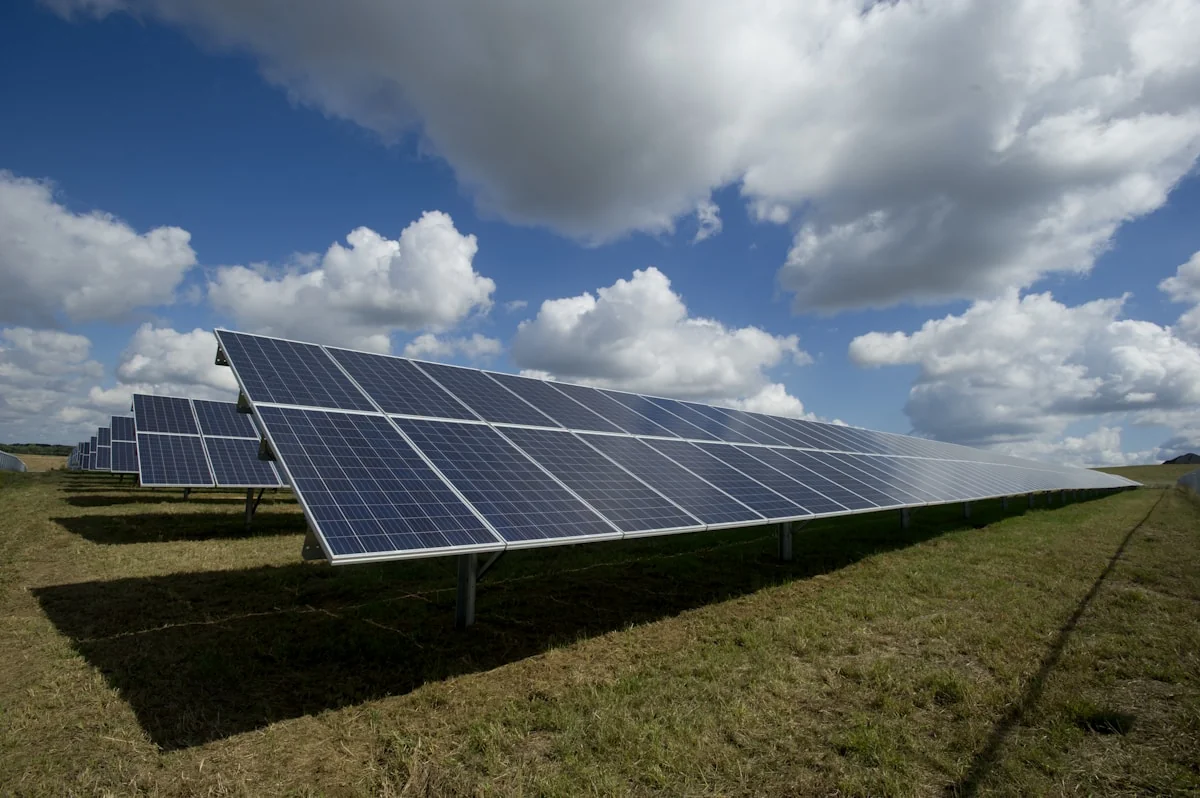
Renewable energy installations represent enormous capital investments — a 500 MW wind farm costs $750 million-$1.5 billion; a utility-scale solar facility of similar capacity costs $500-900 million. Improving the energy yield from these assets by even 1-2% generates millions in additional annual revenue with zero additional capital investment. AI optimization is delivering these improvements across the renewable energy asset lifecycle, from site selection through operations and maintenance.
Wind Farm AI Optimization: Wake Steering and Turbine Control
Individual wind turbines create aerodynamic wakes — regions of reduced wind speed and increased turbulence — that reduce the power output of downstream turbines in a wind farm. Conventional turbine control maximizes individual turbine output without accounting for wake effects on neighbors. AI control systems optimize yaw angle (rotational orientation) of upwind turbines to deflect their wakes away from downstream turbines — accepting a small reduction in individual output to achieve higher total farm output.
This approach — called wake steering — has been validated in multiple field trials. NREL’s field experiments demonstrated total farm output improvements of 1.5-3% under optimal conditions; commercial deployments by Siemens Gamesa and Vestas report consistent 1-2% improvements across diverse wind conditions. On a 500 MW wind farm generating at 35% capacity factor, a 2% output improvement generates approximately 30,000 MWh additional annual production worth $1.5-3 million at typical wholesale prices.
DeepMind’s collaboration with Google’s wind energy portfolio in the central U.S. demonstrated that AI wind power forecasting 36 hours ahead increased the economic value of wind energy by approximately 20% — achieved by enabling advance power purchase commitments to grid operators at higher fixed prices rather than selling all output at real-time spot prices. For a large wind portfolio, this revenue improvement is transformational.
Solar Farm AI: From Soiling Detection to MPPT Optimization
AI Soiling Detection and Cleaning Optimization
Solar panel soiling — dust, pollen, bird droppings accumulating on panel surfaces — reduces energy output by 5-25% depending on location and season. Optimal cleaning schedules balance cleaning cost against the revenue value of improved output. AI soiling detection systems use drone imagery, satellite data, and production monitoring to detect soiling rates across large solar arrays at the string level — identifying which sections require priority cleaning and which are clean enough to defer.
Raptor Maps and Zeitview (formerly DroneBase) deploy thermal drone imaging to identify not just soiling but module-level faults — hot spots, bypass diode failures, cracked cells — that reduce individual panel output without being detectable from aggregate production monitoring. A single drone inspection of a 100 MW solar facility identifies $500,000-$2,000,000 in annual energy loss from correctable faults, with inspection costs of $15,000-$30,000.
AI Maximum Power Point Tracking
Each solar panel has a maximum power point (MPP) — the operating voltage and current combination that maximizes output under current irradiance and temperature conditions. Traditional MPPT algorithms find this point using simple hill-climbing approaches that can be slow and get trapped in local maxima under partial shading conditions. AI-enhanced MPPT uses predictive models that anticipate changing irradiance conditions and optimize setpoints proactively — achieving 2-5% higher energy yield under variable cloud conditions compared to conventional algorithms.
Energy Yield Prediction: AI for Solar Development
Before a solar or wind project is financed, developers must predict its lifetime energy yield with sufficient accuracy to secure project financing. AI energy yield prediction tools — integrating satellite irradiance data, historical weather patterns, terrain modeling, and system degradation rates — are producing predictions with mean absolute errors of 2-4% on an annual basis, compared to 5-8% for traditional energy assessment methods. More accurate yield predictions reduce financing costs by reducing lender uncertainty about project revenue — directly improving project economics.
Predictive Maintenance for Renewable Assets
Solar inverters and wind turbine drivetrain components are the most expensive and failure-prone components in renewable energy assets. AI predictive maintenance for solar inverters — analyzing electrical output patterns, temperature signatures, and component aging models — identifies inverters approaching failure 4-8 weeks before they fail, enabling planned replacement that avoids unscheduled downtime. For wind turbines, gearbox and main bearing monitoring using vibration analysis and oil particle counting detects developing failures months in advance, enabling repair during low-wind periods that minimizes lost generation.
Related: AI in Energy 2026 | AI Smart Grid Management | AI in Manufacturing 2026
Authoritative source: The NREL Wind Energy Research publishes the most rigorous independent studies of wind farm wake effects and AI-based optimization strategies — providing validated performance data that contextualizes vendor AI optimization claims with independently measured outcomes from field trials.